February 2007
Intermediate to advanced
464 pages
14h 40m
English
Almost 20 years after the launch of the audio CD format [PhSo82] [IECA87], Philips and Sony established a new storage format called the “super-audio CD” (SACD) [SACD02] [SACD03]. Unlike the conventional CD format that employs PCM encoding with a 16-bit resolution and a sampling rate of 44.1 kHz, the SACD system uses a superior 1-bit recording technology called direct stream digital (DSD) [Nish96a] [Nish96b] [Reef01a]. SACD operates at a sampling frequency 64 times the rate used in conventional CDs, i.e., 64 × 44.1 kHz = 2.8224 MHz.
Table 11.2. Conventional CDs versus the next generation storage formats.


Figure 11.8. MLP encoding scheme [Gerz99].
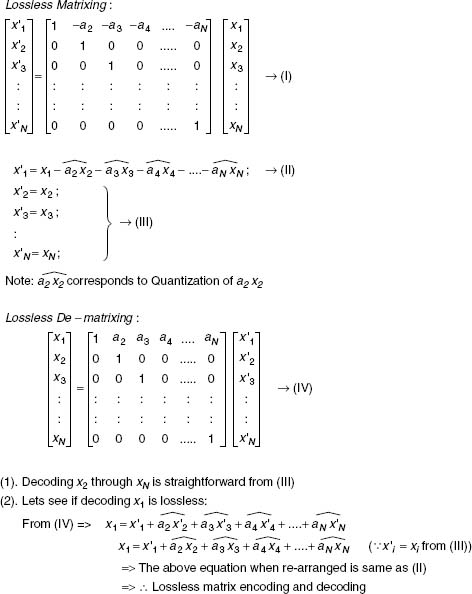
Figure 11.9. Lossless matrixing in MLP.
Moreover, SACD enables frequency response from DC to 100 kHz with a dynamic range of 120 dB. SACD systems enable both high-resolution surround sound audio recordings (5.1 or 3/2-channel format) as well as high-quality stereo encoding. Some important characteristics of the red book audio CD format [IECA87] and the SACD and DVD-audio storage formats are summarized in Table 11.2.
The main idea behind the DSD technology is to avoid the decimation and interpolation filters that ...
Read now
Unlock full access


 O’Reilly covers everything we've got, with content to help us build a world-class technology community, upgrade the capabilities and competencies of our teams, and improve overall team performance as well as their engagement.I wanted to learn C and C++, but it didn't click for me until I picked up an O'Reilly book. When I went on the O’Reilly platform, I was astonished to find all the books there, plus live events and sandboxes so you could play around with the technology.I’ve been on the O’Reilly platform for more than eight years. I use a couple of learning platforms, but I'm on O'Reilly more than anybody else. When you're there, you start learning. I'm never disappointed.I'm always learning. So when I got on to O'Reilly, I was like a kid in a candy store. There are playlists. There are answers. There's on-demand training. It's worth its weight in gold, in terms of what it allows me to do.