December 1994
Intermediate to advanced
606 pages
16h 7m
English
When a spawned process closes its connection to Expect, the expect command sees an eof.
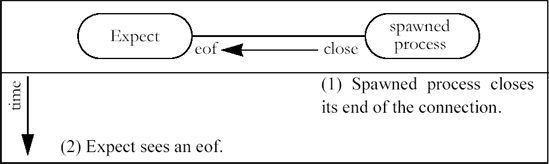
Figure 4-1.
This scenario can also occur in the reverse direction. Expect can close the connection and the spawned process will see an eof.
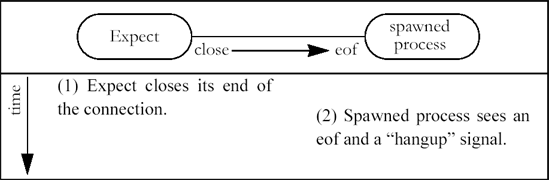
Figure 4-2.
By closing the connection, Expect is telling the spawned process that it has nothing more to say to the process. Usually the process takes this as an indication to exit. This is similar to what occurs when you press ^D while manually interacting with a process. The process does not see the ^D. Rather, the system turns this into an eof. The process reads the eof and then responds by closing the connection and exiting.
There is one difference between how Expect and the spawned process treat a closed connection. When Expect closes the connection, the spawned process sees an additional indication in the form of a hangup signal. Most processes take this as an instruction to immediately exit. The net result is very similar to reading an eof. In either case, the process exits. Later in the book, I will go into more detail about what signals are and how you can ignore them or take advantage of them.
From Expect, the command to close the connection to a process is close. It is called as:
close
No matter which side—the Expect process or the spawned ...
Read now
Unlock full access


 O’Reilly covers everything we've got, with content to help us build a world-class technology community, upgrade the capabilities and competencies of our teams, and improve overall team performance as well as their engagement.I wanted to learn C and C++, but it didn't click for me until I picked up an O'Reilly book. When I went on the O’Reilly platform, I was astonished to find all the books there, plus live events and sandboxes so you could play around with the technology.I’ve been on the O’Reilly platform for more than eight years. I use a couple of learning platforms, but I'm on O'Reilly more than anybody else. When you're there, you start learning. I'm never disappointed.I'm always learning. So when I got on to O'Reilly, I was like a kid in a candy store. There are playlists. There are answers. There's on-demand training. It's worth its weight in gold, in terms of what it allows me to do.