December 1994
Intermediate to advanced
606 pages
16h 7m
English
The pattern a*((ab)*|b*) has nested parentheses. How are the results stored in the array expect_out? They are determined by counting left parentheses: the subexpression which starts with the Nth left parenthesis corresponds with expect_out(N,...). For example, the string that matches ((ab)*|b*) is stored in expect_out(1,string), and the string that matches (ab) is stored in expect_out(2,string). Of course, the only string that could possibly match "ab" is "ab“. If you want to record the string of ab’s that corresponds to (ab)* then you have to put another pair of parentheses around that, as in "((ab)*)“.
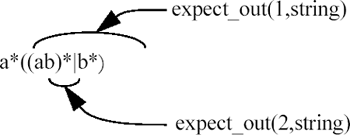
Figure 5-1. Strings that match parenthesized subpatterns are stored in the expect_out array
The string matched by the whole pattern is stored in expect_out(0,string). This makes sense if you imagine the whole pattern is wrapped in another set of parentheses. And you can also imagine the whole pattern prefaced by a .* pattern[23] and wrapped in yet another pair of parentheses to determine the value of expect_out(buffer).
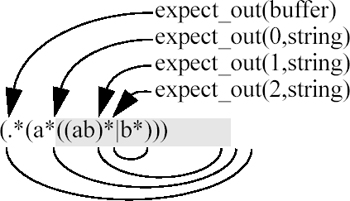
Figure 5-2. The original pattern is shaded. Text that matches the imaginary pattern (.*(...)) is stored in expect(0,string) and expect_out(buffer).
[23] Unlike the usual meaning of .* which matches as many characters as possible, this imaginary .* matches ...
Read now
Unlock full access


 O’Reilly covers everything we've got, with content to help us build a world-class technology community, upgrade the capabilities and competencies of our teams, and improve overall team performance as well as their engagement.I wanted to learn C and C++, but it didn't click for me until I picked up an O'Reilly book. When I went on the O’Reilly platform, I was astonished to find all the books there, plus live events and sandboxes so you could play around with the technology.I’ve been on the O’Reilly platform for more than eight years. I use a couple of learning platforms, but I'm on O'Reilly more than anybody else. When you're there, you start learning. I'm never disappointed.I'm always learning. So when I got on to O'Reilly, I was like a kid in a candy store. There are playlists. There are answers. There's on-demand training. It's worth its weight in gold, in terms of what it allows me to do.