December 2022
Beginner to intermediate
618 pages
12h 41m
English
In this chapter, you will investigate the use of different types of motors with the Raspberry Pi. This includes DC motors, servomotors, and stepper motors.
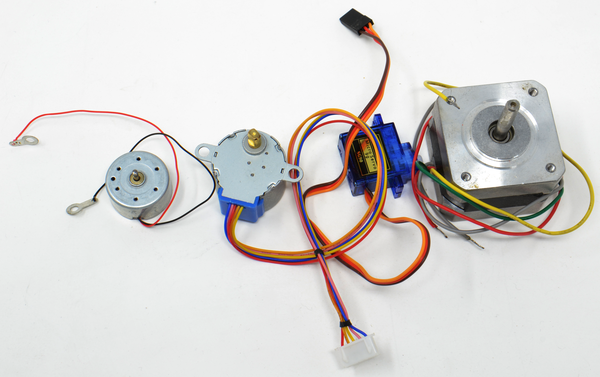
Motors come in all shapes and sizes (Figure 12-1). The most common is the simple brushed DC motor that you might find in a toy car. In this chapter, we will also look at servomotors, where the position of the motor’s shaft is set using pulses generated by the Raspberry Pi, and at stepper motors, which don’t rotate smoothly, but, as the name suggests, in tiny steps, as their coils are energized in sequence.
You want to use a Raspberry Pi to control the position of a servomotor.
Use pulse-width modulation (PWM) to control the width of pulses to a servomotor to change its angle. Although this will work, the PWM generated is not completely stable, so there will be a little bit of jitter with the servo. For alternative solutions that produce much more stable pulse timing, see Recipes 12.2 and 12.3.
If you have a Raspberry Pi 1, you should power the servo from a separate 5V power supply because peaks in the load current are very likely to crash or overload the Raspberry Pi. If you have a Raspberry Pi B+ or newer, improvements in the onboard voltage regulation mean that you might get away with powering small ...
Read now
Unlock full access


 O’Reilly covers everything we've got, with content to help us build a world-class technology community, upgrade the capabilities and competencies of our teams, and improve overall team performance as well as their engagement.I wanted to learn C and C++, but it didn't click for me until I picked up an O'Reilly book. When I went on the O’Reilly platform, I was astonished to find all the books there, plus live events and sandboxes so you could play around with the technology.I’ve been on the O’Reilly platform for more than eight years. I use a couple of learning platforms, but I'm on O'Reilly more than anybody else. When you're there, you start learning. I'm never disappointed.I'm always learning. So when I got on to O'Reilly, I was like a kid in a candy store. There are playlists. There are answers. There's on-demand training. It's worth its weight in gold, in terms of what it allows me to do.