August 2002
Beginner
496 pages
14h 43m
English
The information architecture community has much to learn from this expansive, honest, multifaceted approach to strategy. We are a young field, and we often resemble the illustration that accompanies The Blind Men and the Elephant (Figure 18-6). We have yet to develop our schools of thought. And our elephant is a complex, dynamic, and elusive beast. Building towards a collective understanding of information architecture is exasperatingly difficult.
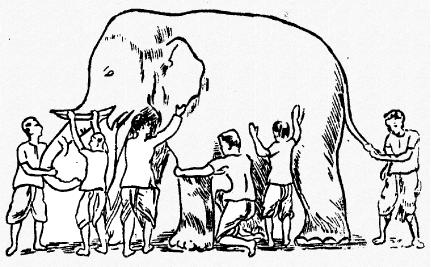
Figure 18-6. The Blind Men and the Elephant (image from http://www.jainworld.com/literature/story25i1.gif)
As we continue to formulate our ideas and methods, we should be wary of those who expound a “one best way.” We should embrace many definitions, many methods, and many facets. We should also be on the lookout for early indicators of trends that suggest new directions and new schools of thought for information architecture. It would be naïve to think our practice has matured in less than a decade.
This is not to say that we haven’t made great progress already. The practice of information architecture has come a long way since the early 1990s. We began with highly centralized, top-down approaches, attempting to leverage careful planning into stable solutions. We did some good work, but learned the hard way that change is a constant and surprises should be expected. More recently, we’ve been exploring bottom-up ...
Read now
Unlock full access


 O’Reilly covers everything we've got, with content to help us build a world-class technology community, upgrade the capabilities and competencies of our teams, and improve overall team performance as well as their engagement.I wanted to learn C and C++, but it didn't click for me until I picked up an O'Reilly book. When I went on the O’Reilly platform, I was astonished to find all the books there, plus live events and sandboxes so you could play around with the technology.I’ve been on the O’Reilly platform for more than eight years. I use a couple of learning platforms, but I'm on O'Reilly more than anybody else. When you're there, you start learning. I'm never disappointed.I'm always learning. So when I got on to O'Reilly, I was like a kid in a candy store. There are playlists. There are answers. There's on-demand training. It's worth its weight in gold, in terms of what it allows me to do.