October 2000
Intermediate to advanced
288 pages
9h 22m
English
The structure of the taxonomy concerning implementation issues is shown in Fig. 3.8. A discussion of this taxonomy then follows.
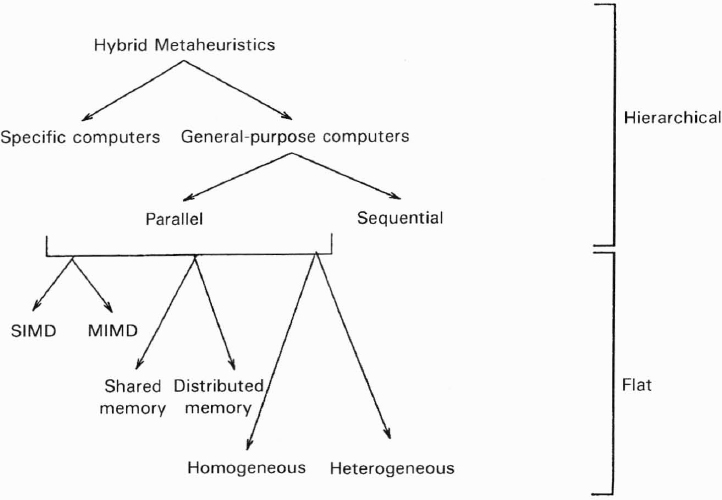
Figure 3.8 Classification of hybrid metaheuristic (implementation issues).
Application-specific computers differ from general-purpose ones in that they usually only solve a small range of problems, but often at much higher rates and lower cost. Their internal structure is tailored for a particular problem, and thus can achieve much higher efficiency and hardware utilization than a processor that must handle a wide range of tasks.
Recently, the advent of programmable logic devices has made it easier to build specific computers for metaheuristics such as simulated annealing [3] and genetic algorithms [59]. A general architecture acting as a template for designing a number of specific machines for different metaheuristics (SA, TS, etc) has been proposed in [2]. The processor is built with XILINX FPGAs and APT1X interconnexion chips. Experiments evaluating a simulated annealing algorithm to solve the TSP achieves a speedup of about 37 times over an IBM RS6000 workstation. To our knowledge, this approach has not yet been proposed for hybrid metaheuristics.
Most of the proposed hybrid metaheuristics are sequential programs. Parallel implementations of hybrid ...
Read now
Unlock full access


 O’Reilly covers everything we've got, with content to help us build a world-class technology community, upgrade the capabilities and competencies of our teams, and improve overall team performance as well as their engagement.I wanted to learn C and C++, but it didn't click for me until I picked up an O'Reilly book. When I went on the O’Reilly platform, I was astonished to find all the books there, plus live events and sandboxes so you could play around with the technology.I’ve been on the O’Reilly platform for more than eight years. I use a couple of learning platforms, but I'm on O'Reilly more than anybody else. When you're there, you start learning. I'm never disappointed.I'm always learning. So when I got on to O'Reilly, I was like a kid in a candy store. There are playlists. There are answers. There's on-demand training. It's worth its weight in gold, in terms of what it allows me to do.