October 2000
Intermediate to advanced
288 pages
9h 22m
English
Learning systems have been shown to be an efficient tool to deal with a large number of engineering problems. They are information-processing systems whose architecture and behavior are inspired by the structure of biological systems (the organism is born with relatively little initial knowledge and learns actions that are appropriate through trials and errors). The vocabulary and the concepts associated with learning automata are borrowed from biology and psychology.
Learning systems are adaptive machines that interact with an environment (the problem to be solved) and that dynamically learn the optimal action that the environment offers. Thus, a learning automaton is connected in a feedback loop to the environment, where the input to one is the output to the other (see Fig. 4.7). At every iteration (or sampling period), the automaton chooses an action from a finite action set, on the basis of the probability distribution. The selected action causes the reaction of the environment, which in turn is the input signal for the automaton. The role of the environment is therefore to establish the relation between the actions of the automata and the signal received at its input. In an adaptive systems, the learning automaton recursively updates its probability distribution on the basis of the environment response.
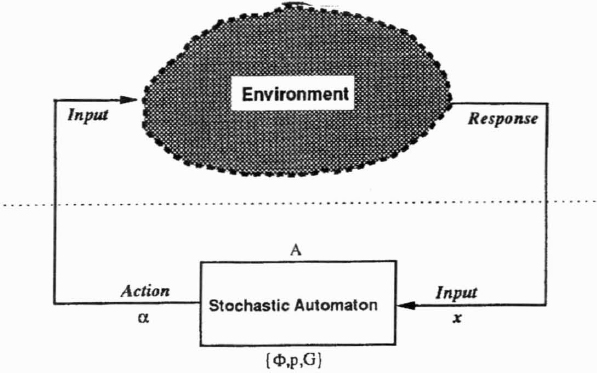
Figure 4.7 Stochastic learning automaton. ...
Read now
Unlock full access


 O’Reilly covers everything we've got, with content to help us build a world-class technology community, upgrade the capabilities and competencies of our teams, and improve overall team performance as well as their engagement.I wanted to learn C and C++, but it didn't click for me until I picked up an O'Reilly book. When I went on the O’Reilly platform, I was astonished to find all the books there, plus live events and sandboxes so you could play around with the technology.I’ve been on the O’Reilly platform for more than eight years. I use a couple of learning platforms, but I'm on O'Reilly more than anybody else. When you're there, you start learning. I'm never disappointed.I'm always learning. So when I got on to O'Reilly, I was like a kid in a candy store. There are playlists. There are answers. There's on-demand training. It's worth its weight in gold, in terms of what it allows me to do.