April 2005
Intermediate to advanced
400 pages
12h 4m
English
The best way to manage ideas is to start any major design work with clear checkpoints for how the time should be used. Instead of having only two checkpoints, requirements (or problem definition), and spec writing, some intermediary points need to be defined before creative work is going at full speed. It's the project manager's job to make sure these points in time are created (and that everyone understands their usefulness), although it might be best if the designers or engineers define the specifics for when those points in time occur and what the criteria should be for reaching them.(2) There are many different ways to do this, and the best way will vary from project to project and team to team. But, as a basic rule of thumb, here are the key points in time (illustrated in Figure 6-3).
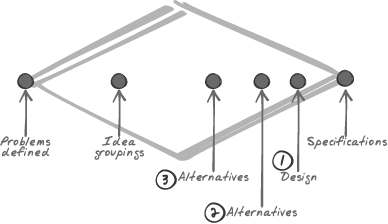
Vision and proof-of-concept. If the vision document is delivered with a proof of concept prototype, the design and creative effort has a head start. There will already be design ideas and engineering concepts to investigate and build off of (or reject, but with improved understanding of the problem). It's not a good vision if it doesn't have at least a rough proof- of-concept design prototype.
Idea groupings/lists. After the initial wave of new ideas and possible approaches are raised, someone has to organize and consolidate ...
Read now
Unlock full access


 O’Reilly covers everything we've got, with content to help us build a world-class technology community, upgrade the capabilities and competencies of our teams, and improve overall team performance as well as their engagement.I wanted to learn C and C++, but it didn't click for me until I picked up an O'Reilly book. When I went on the O’Reilly platform, I was astonished to find all the books there, plus live events and sandboxes so you could play around with the technology.I’ve been on the O’Reilly platform for more than eight years. I use a couple of learning platforms, but I'm on O'Reilly more than anybody else. When you're there, you start learning. I'm never disappointed.I'm always learning. So when I got on to O'Reilly, I was like a kid in a candy store. There are playlists. There are answers. There's on-demand training. It's worth its weight in gold, in terms of what it allows me to do.