September 2008
Intermediate to advanced
286 pages
5h 43m
English
I can prove anything on a double-axis chart,[] but the matrix in Figure 1.1. happens to hold true. As you can see in the figure, the ideal relationship occurs when buyer commitment to the project (and to you) is high and your fee is high. If buyer commitment is high and your fee is low, you are wasting an opportunity. If buyer commitment is low and your fee is low, you will, at best, create an indifferent sale. And when fees are high but commitment is low, you will be shown the door.
[] In fact, my Great Big Book of Process Visuals bears the subtitle Give Me a Double-Axis Chart and I Can Rule the World.
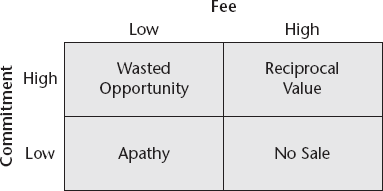
My estimate is that most consultants' approaches (whether or not they actually get the business) are in the bottom left quadrant about 25 percent of the time, in the bottom right quadrant about 10 percent of the time, in the upper left quadrant about 60 percent of the time, and in the upper right quadrant only about 5 percent of the time!
That's right: most consultants, including most of you reading this, habitually undercharge for your services and deliver far more than you are receiving in remuneration, considering your contribution to success. You are undercharging and overdelivering, and lest you consider that an exalted position, consider trying to pay your ...