June 2001
Intermediate to advanced
320 pages
9h 18m
English
In this section, I provide a few clues into the temporal characteristics of web objects. By analyzing Squid’s store.log files, we can see how old an object is when it enters the cache, when it was last modified, and when it expires.
Age, expiration, and modification time calculations depend on
the presence of certain HTTP headers. The Date header
is quite common, but the Expires header is rare. If a header
is missing or invalid, the response is not included in
the analysis.
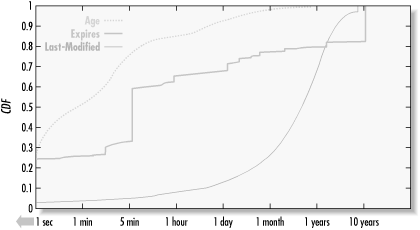
Figure A-10. Distribution of object ages, modification, and expiration times (IRCache data)
In Figure A-10, you’ll see cumulative
distribution (CDF) plots for object age, time since
modification, and time until expiration. Age values are taken
from the HTTP Age header or, in most cases,
by subtracting the Date header value from the current time.
Whenever a cache receives a response from an origin server,
the object’s age should be zero. However, the age may be
nonzero for one or more of the following reasons:
The origin server’s clock may be wrong. Even if the
response is generated at the current time, the server’s
Date header may be in the future or the past by a
significant amount. In this analysis, negative age values
are discarded.
The response may have been served from a neighbor cache rather than the origin server. Most IRCache proxies have neighbors, so it’s likely that about 5% of requests ...
Read now
Unlock full access


 O’Reilly covers everything we've got, with content to help us build a world-class technology community, upgrade the capabilities and competencies of our teams, and improve overall team performance as well as their engagement.I wanted to learn C and C++, but it didn't click for me until I picked up an O'Reilly book. When I went on the O’Reilly platform, I was astonished to find all the books there, plus live events and sandboxes so you could play around with the technology.I’ve been on the O’Reilly platform for more than eight years. I use a couple of learning platforms, but I'm on O'Reilly more than anybody else. When you're there, you start learning. I'm never disappointed.I'm always learning. So when I got on to O'Reilly, I was like a kid in a candy store. There are playlists. There are answers. There's on-demand training. It's worth its weight in gold, in terms of what it allows me to do.