June 2008
Beginner to intermediate
440 pages
11h 56m
English
It is possible to relate the P/E ratio to a DCF model for a mature, stable firm. Consider the fundamental equation for a P/E multiple below. Its implications illustrate that a simple P/E ratio contains a number of accounting and valuation deficiencies. The forward P/E1 can be calculated for a firm with constant earnings growth, g, and a constant perpetual return on equity, ROE. The term rE represents the cost of equity.
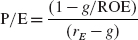
Critical readers are doubtless wondering how many firms meet these restrictive conditions. To make matters worse, accounting dependencies and deficiencies are manifold. Earnings and the subsequent ROE can be altered by any number of accounting decisions:
Note how important ROE is to the P/E ratio. Earnings quality should be an intrinsic consideration when ...
Read now
Unlock full access


 O’Reilly covers everything we've got, with content to help us build a world-class technology community, upgrade the capabilities and competencies of our teams, and improve overall team performance as well as their engagement.I wanted to learn C and C++, but it didn't click for me until I picked up an O'Reilly book. When I went on the O’Reilly platform, I was astonished to find all the books there, plus live events and sandboxes so you could play around with the technology.I’ve been on the O’Reilly platform for more than eight years. I use a couple of learning platforms, but I'm on O'Reilly more than anybody else. When you're there, you start learning. I'm never disappointed.I'm always learning. So when I got on to O'Reilly, I was like a kid in a candy store. There are playlists. There are answers. There's on-demand training. It's worth its weight in gold, in terms of what it allows me to do.