March 2011
Intermediate to advanced
368 pages
9h 45m
English
REBALANCING WHEN TIMES ARE BAD
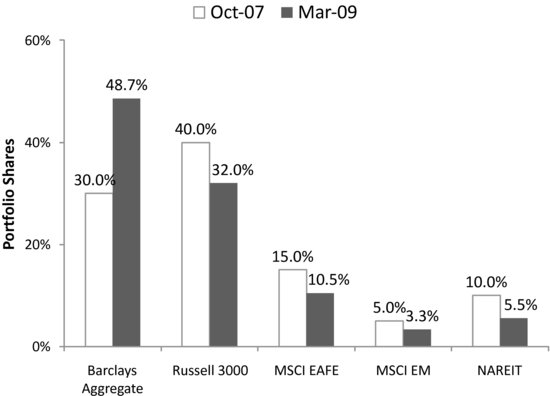
If it seems difficult to rebalance when markets are soaring, it is even more difficult to do so when markets are tumbling. Consider the experience of investors during the bust from October 2007 through March 2009.2 During that period, the S&P 500 fell by almost 47 percent as did the Russell 3000. Foreign stocks fell even more, EAFE by 53.6 percent and MSCI Emerging Markets by 55.9 percent. REITS topped them all by falling 63.4 percent.
Figure 16.4 shows how these sharp losses distorted the asset allocation. The bond allocation drifted upward from 30 percent of the portfolio to 48.7 percent. The U.S. stock allocation plummeted by 8 percent, foreign stocks by 4.5 percent. REITS fell from 10 percent of the portfolio to 5.5 percent.
FIGURE 16.4 Drift of Portfolio Shares in Bust
Data Sources: Barclays Capital, Russell®, MSCI, and ©FTSE.
What should the investor have done in that bleak winter of 2008 and 2009? If the investor followed a disciplined approach to asset allocation, the portfolio should have been rebalanced at the trough or, perhaps more realistically, early in 2009 when annual returns were reported for 2008. But what tremendous discipline would have been required! The United States and the world as a whole had just gone through the worst financial crisis since the 1930s depression. Several major financial institutions had failed or had been ...
Read now
Unlock full access


 O’Reilly covers everything we've got, with content to help us build a world-class technology community, upgrade the capabilities and competencies of our teams, and improve overall team performance as well as their engagement.I wanted to learn C and C++, but it didn't click for me until I picked up an O'Reilly book. When I went on the O’Reilly platform, I was astonished to find all the books there, plus live events and sandboxes so you could play around with the technology.I’ve been on the O’Reilly platform for more than eight years. I use a couple of learning platforms, but I'm on O'Reilly more than anybody else. When you're there, you start learning. I'm never disappointed.I'm always learning. So when I got on to O'Reilly, I was like a kid in a candy store. There are playlists. There are answers. There's on-demand training. It's worth its weight in gold, in terms of what it allows me to do.