December 2026
Beginner to intermediate
484 pages
12h 41m
English
When we talk about modern generative AI systems such as ChatGPT, Claude, Gemini, or the Llama chat models, it is easy to forget that they were not built from scratch for a single task. They were not originally designed only to chat, summarize documents, or answer questions. Instead, they began as pretrained foundation models: large models trained on massive and diverse datasets of text, code, and other data before being adapted for specific behaviors.
As discussed in Chapter 1, an LLM is shaped in three training stages: pretraining, fine-tuning, and alignment. A fourth phase, inference and deployment, is where the finished model actually serves users; we treat it separately because it does not change the model’s weights. In this chapter we focus on the first stage, pretraining, the stage that produces the pretrained model, often also called a foundation model or base model. Figure 2-1 highlights this stage.
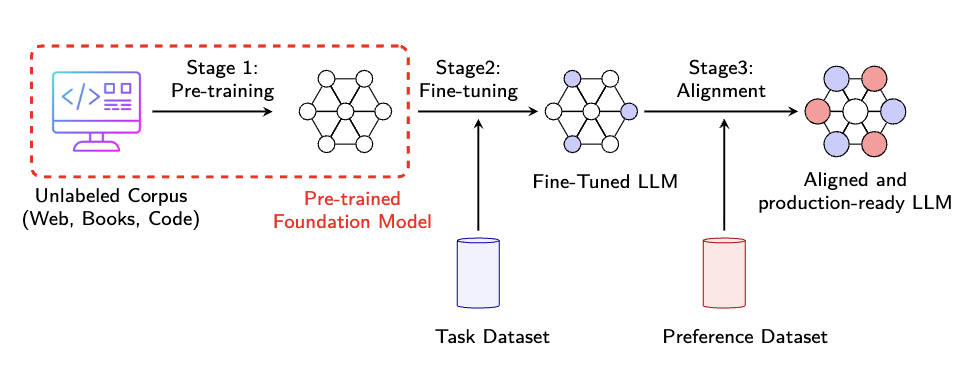
Table 2-1 shows how several well-known families move from a pretrained base toward post-trained, aligned models. Notice the split: open-weight providers publish the base model and usually one or more post-trained checkpoints, while the closed labs release only a finished, aligned product.
Read now
Unlock full access


 O’Reilly covers everything we've got, with content to help us build a world-class technology community, upgrade the capabilities and competencies of our teams, and improve overall team performance as well as their engagement.I wanted to learn C and C++, but it didn't click for me until I picked up an O'Reilly book. When I went on the O’Reilly platform, I was astonished to find all the books there, plus live events and sandboxes so you could play around with the technology.I’ve been on the O’Reilly platform for more than eight years. I use a couple of learning platforms, but I'm on O'Reilly more than anybody else. When you're there, you start learning. I'm never disappointed.I'm always learning. So when I got on to O'Reilly, I was like a kid in a candy store. There are playlists. There are answers. There's on-demand training. It's worth its weight in gold, in terms of what it allows me to do.