December 2026
Beginner to intermediate
484 pages
12h 41m
English
A pretrained language model knows a great deal about language but has no particular incentive to be helpful, truthful, or safe. It will happily complete any text pattern, including toxic, misleading, or dangerous ones. The reason for this is that its training objective, next-token prediction, is agnostic to these concerns. Alignment is the process of shaping a model’s behavior so that its outputs reflect human values and intentions, not just statistical patterns in the training data.
The dominant framework for thinking about alignment comes from Anthropic’s HHH criteria: a well-aligned model should be Helpful (understands user intent and provides useful responses), Honest (avoids fabrication, expresses uncertainty when appropriate), and Harmless (refuses dangerous requests and avoids toxic content). These objectives can conflict, and much of the challenge of alignment is in balancing them.
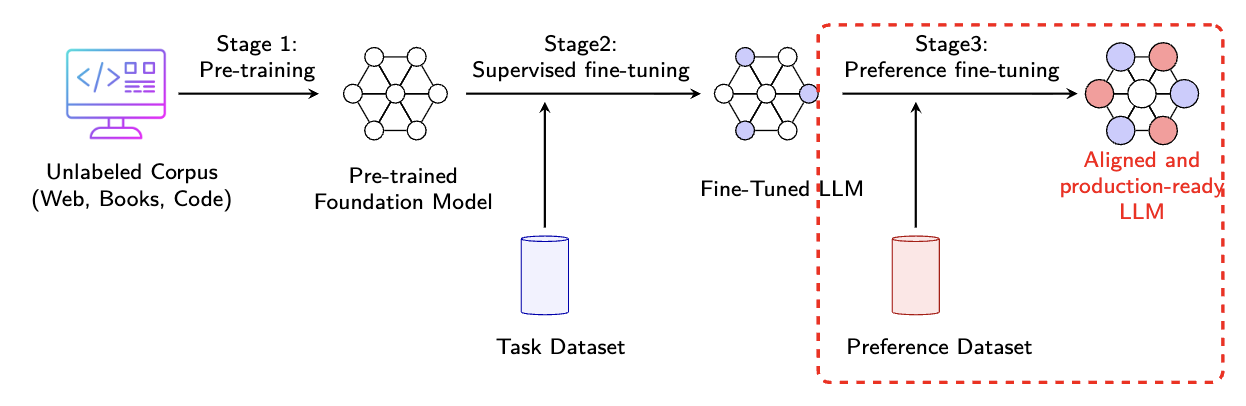
In the standard training pipeline, alignment is the final stage, shown in Figure 11-1. After pretraining on large text corpora (Chapter 2) and supervised fine-tuning on instruction-response pairs (Chapter 10), the model undergoes alignment training to learn which behaviors are preferred.
Read now
Unlock full access


 O’Reilly covers everything we've got, with content to help us build a world-class technology community, upgrade the capabilities and competencies of our teams, and improve overall team performance as well as their engagement.I wanted to learn C and C++, but it didn't click for me until I picked up an O'Reilly book. When I went on the O’Reilly platform, I was astonished to find all the books there, plus live events and sandboxes so you could play around with the technology.I’ve been on the O’Reilly platform for more than eight years. I use a couple of learning platforms, but I'm on O'Reilly more than anybody else. When you're there, you start learning. I'm never disappointed.I'm always learning. So when I got on to O'Reilly, I was like a kid in a candy store. There are playlists. There are answers. There's on-demand training. It's worth its weight in gold, in terms of what it allows me to do.