December 2026
Beginner to intermediate
484 pages
12h 41m
English
Training large language models involves coordinating multiple components that work together to form the end-to-end training pipeline. Figure 9-1 shows these components.
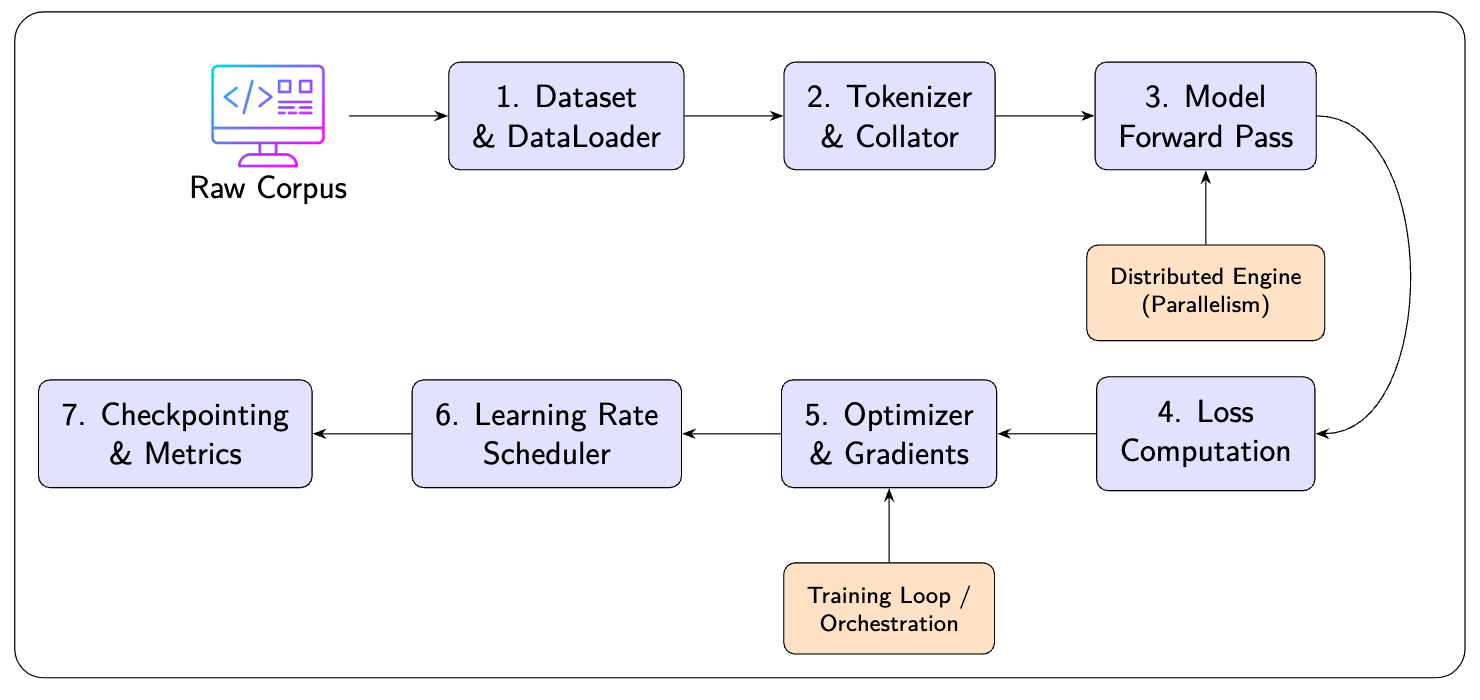
First, the Dataset and DataLoader decide which data points are available to form a batch. Then the Tokenizer and Data Collator decide how that batch is packaged into the exact tensor shapes and fields that the model expects. Then the model runs a forward pass on those tensors to produce predictions. A loss function compares the predictions to the targets to compute a scalar loss, and backpropagation computes gradients that the optimizer uses to update the model parameters. Finally, the scheduler updates the learning rate and the training loop records metrics and checkpoints so training can be monitored and resumed.
In this chapter, we unpack the core building blocks of the training pipeline and discuss training optimization techniques.
This section introduces the core components of the LLM training pipeline, from raw data to parameter updates. We begin with how training examples are loaded and prepared, ...
Read now
Unlock full access


 O’Reilly covers everything we've got, with content to help us build a world-class technology community, upgrade the capabilities and competencies of our teams, and improve overall team performance as well as their engagement.I wanted to learn C and C++, but it didn't click for me until I picked up an O'Reilly book. When I went on the O’Reilly platform, I was astonished to find all the books there, plus live events and sandboxes so you could play around with the technology.I’ve been on the O’Reilly platform for more than eight years. I use a couple of learning platforms, but I'm on O'Reilly more than anybody else. When you're there, you start learning. I'm never disappointed.I'm always learning. So when I got on to O'Reilly, I was like a kid in a candy store. There are playlists. There are answers. There's on-demand training. It's worth its weight in gold, in terms of what it allows me to do.