December 2026
Beginner to intermediate
484 pages
12h 41m
English
In previous chapters, we explored how language models acquire knowledge through pretraining (Chapter 2), how prompting strategies elicit better answers (Chapter 3), how fine-tuning and reinforcement learning shape model behavior ( Chapters 10 and 11), and how RLHF aligns models with human preferences (Chapter 11). This chapter brings these threads together around a single question: can language models reason?
The answer is yes, but not in the same way humans do, and not always reliably.
In this chapter, we discuss how reasoning models work, how they are trained and evaluated, and where they still fail. We begin with the types of reasoning that matter, then examine the techniques that enable them.
Not all reasoning is the same. Reasoning comes in many forms, and LLM capabilities vary across them. Figure 12-1 summarizes the main types and shows where current LLMs tend to be stronger or weaker.
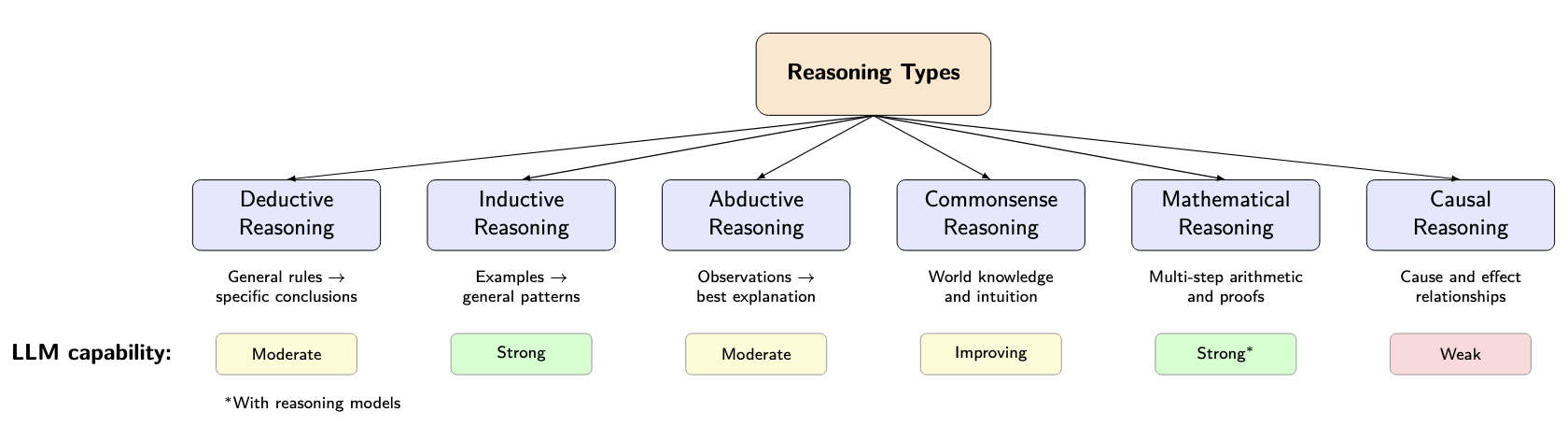
Deductive reasoning applies general rules to specific cases to reach a logically certain conclusion. “All mammals are warm-blooded. A whale is a mammal. Therefore, a whale is warm-blooded.” LLMs handle simple one- or two-step deductions well, but their performance degrades substantially as the number of chained steps increases. Saparov and ...
Read now
Unlock full access


 O’Reilly covers everything we've got, with content to help us build a world-class technology community, upgrade the capabilities and competencies of our teams, and improve overall team performance as well as their engagement.I wanted to learn C and C++, but it didn't click for me until I picked up an O'Reilly book. When I went on the O’Reilly platform, I was astonished to find all the books there, plus live events and sandboxes so you could play around with the technology.I’ve been on the O’Reilly platform for more than eight years. I use a couple of learning platforms, but I'm on O'Reilly more than anybody else. When you're there, you start learning. I'm never disappointed.I'm always learning. So when I got on to O'Reilly, I was like a kid in a candy store. There are playlists. There are answers. There's on-demand training. It's worth its weight in gold, in terms of what it allows me to do.