December 2026
Beginner to intermediate
484 pages
12h 41m
English
How do you know if a language model is good? The question sounds simple, but it turns out to be one of the hardest problems in the field. A model that aces a multiple-choice benchmark may hallucinate wildly in open-ended conversation. One that writes fluent prose may confidently state false facts. Another that scores perfectly on reasoning tests may have memorized the answers from its training data.
Evaluation is therefore not a final step performed after a model is built; it happens throughout the entire development lifecycle. As Figure 5-1 shows, after pretraining, general benchmarks measure the capabilities of the foundation model. During fine-tuning, task-specific evaluations measure whether the model has learned the desired behavior. During alignment, evaluation focuses on properties such as helpfulness, safety, and adherence to human preferences. And after deployment, teams continue evaluating the system through production metrics, monitoring, and real-world feedback.
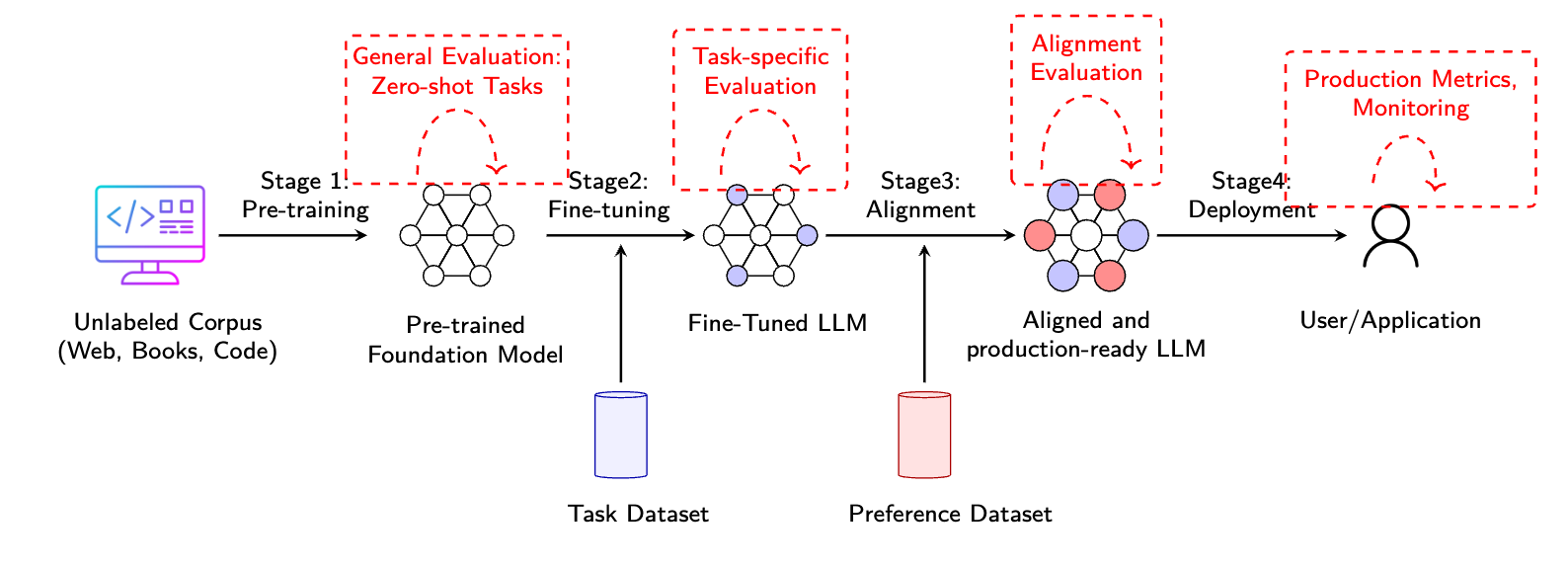
Evaluation touches every aspect of this book: Chapter 4 introduced RAG evaluation through the faithfulness-relevance-quality triad and agent evaluation via task completion metrics. Chapter 11 covers alignment evaluation. Chapter 12 ...
Read now
Unlock full access


 O’Reilly covers everything we've got, with content to help us build a world-class technology community, upgrade the capabilities and competencies of our teams, and improve overall team performance as well as their engagement.I wanted to learn C and C++, but it didn't click for me until I picked up an O'Reilly book. When I went on the O’Reilly platform, I was astonished to find all the books there, plus live events and sandboxes so you could play around with the technology.I’ve been on the O’Reilly platform for more than eight years. I use a couple of learning platforms, but I'm on O'Reilly more than anybody else. When you're there, you start learning. I'm never disappointed.I'm always learning. So when I got on to O'Reilly, I was like a kid in a candy store. There are playlists. There are answers. There's on-demand training. It's worth its weight in gold, in terms of what it allows me to do.