December 2026
Beginner to intermediate
484 pages
12h 41m
English
One of the most practical constraints in any LLM is its context length. A model’s context length is the length of its context window, and it refers to the maximum number of tokens a model can receive and process at once. Context length determines how much information you can give the model in a single forward pass.
You may ask why context length is a constraint. The reason is that if the length of your input exceeds the context window, something must be dropped, truncated, or summarized.
The context length is chosen when a model is designed and trained. After the model is deployed, the context length is typically fixed. That means the model cannot accept inputs longer than that limit without special techniques to extend it.
For a long time, the context window of most popular LLMs was only a few thousand tokens. Then it slowly increased over time as new model versions were released. Recently, the context window of many models has increased to 10 to 100 times larger than before. Figure 14-1 shows a snapshot of today’s models and their documented context sizes.
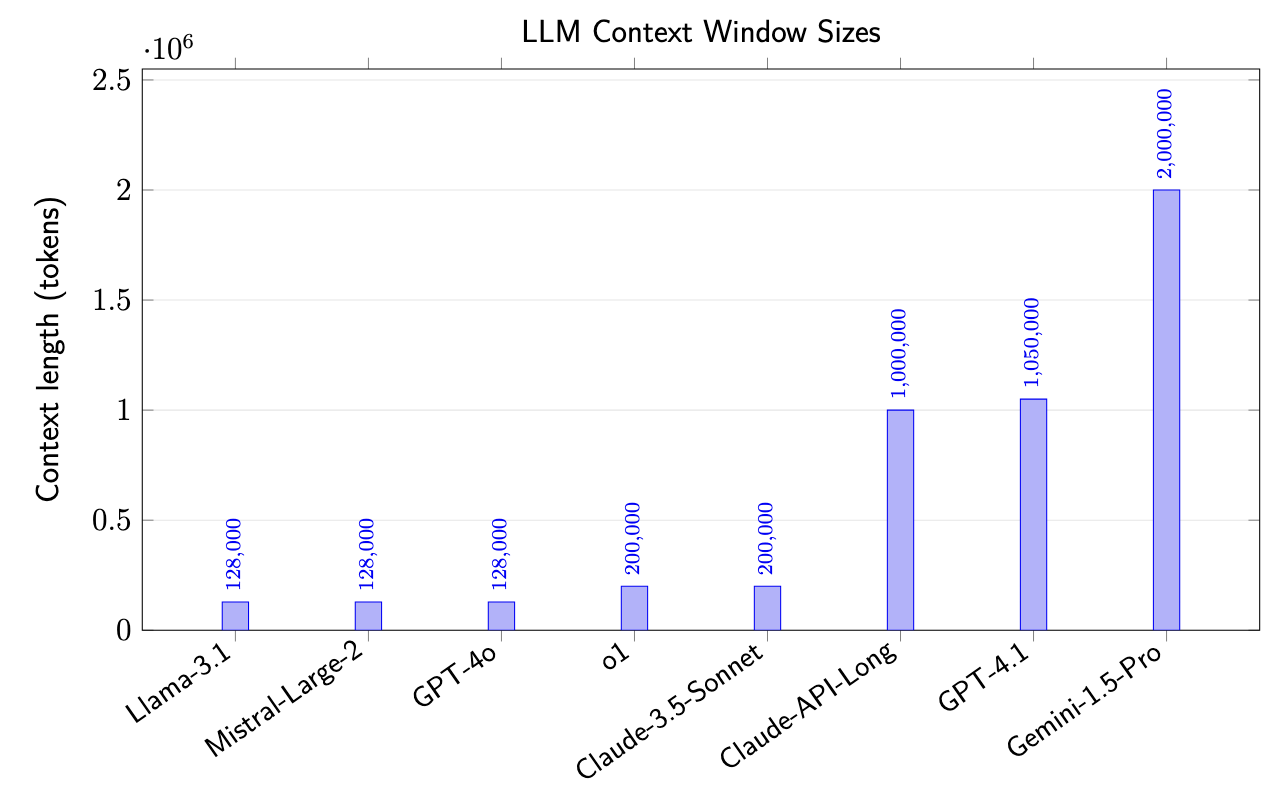
Context length is an important capability because it shapes what problems an LLM can solve directly. ...
Read now
Unlock full access


 O’Reilly covers everything we've got, with content to help us build a world-class technology community, upgrade the capabilities and competencies of our teams, and improve overall team performance as well as their engagement.I wanted to learn C and C++, but it didn't click for me until I picked up an O'Reilly book. When I went on the O’Reilly platform, I was astonished to find all the books there, plus live events and sandboxes so you could play around with the technology.I’ve been on the O’Reilly platform for more than eight years. I use a couple of learning platforms, but I'm on O'Reilly more than anybody else. When you're there, you start learning. I'm never disappointed.I'm always learning. So when I got on to O'Reilly, I was like a kid in a candy store. There are playlists. There are answers. There's on-demand training. It's worth its weight in gold, in terms of what it allows me to do.