December 2026
Beginner to intermediate
484 pages
12h 41m
English
In Chapter 3, we looked at prompt engineering as one way to equip LLMs with the information they need. In this chapter, we introduce retrieval-augmented generation (RAG) and show how it evolves into agentic RAG and, ultimately, tool-using agents.
The shortcoming with prompt engineering is that in many real systems, better prompts are not enough. The model may need facts that were never in its training data, details that change frequently, or private information that cannot be included in pretraining. RAG offers a practical and cost-effective alternative; instead of forcing the model to “know” everything, the system retrieves relevant information at runtime and injects it into the model’s context before generation. Figure 4-1 shows the comparison between RAG and prompt engineering.
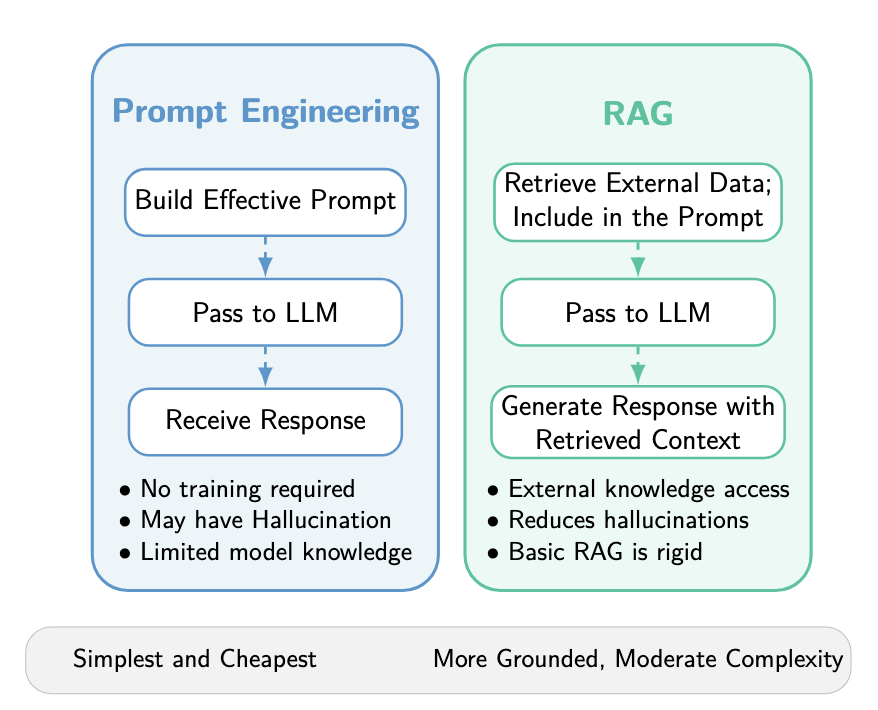
RAG changed how LLM applications are built. Rather than treating the model as a self-contained knowledge base, modern systems increasingly treat it as a reasoning and synthesis engine that operates over external data. We’ll build up to that perspective in three steps:
First, we cover vanilla RAG (also known as classical RAG or basic RAG). In its simplest form, a RAG system retrieves a set of top-k documents relevant to each user query, augments the user query with them, and ...
Read now
Unlock full access


 O’Reilly covers everything we've got, with content to help us build a world-class technology community, upgrade the capabilities and competencies of our teams, and improve overall team performance as well as their engagement.I wanted to learn C and C++, but it didn't click for me until I picked up an O'Reilly book. When I went on the O’Reilly platform, I was astonished to find all the books there, plus live events and sandboxes so you could play around with the technology.I’ve been on the O’Reilly platform for more than eight years. I use a couple of learning platforms, but I'm on O'Reilly more than anybody else. When you're there, you start learning. I'm never disappointed.I'm always learning. So when I got on to O'Reilly, I was like a kid in a candy store. There are playlists. There are answers. There's on-demand training. It's worth its weight in gold, in terms of what it allows me to do.