August 2006
Beginner to intermediate
496 pages
17h 36m
English
HTML normally flows from the top of the browser window down to the bottom, one headline, paragraph, or block-level element on top of another. This word processor–like display is visually boring (Figure 7-12, top), but with CSS, you're far from stuck with it. You'll learn lots of new methods for arranging items on a Web page in Part 3, but you can spice up your pages plenty with one little CSS property— float.
The float property moves an element to either the left or right. In the process, content below the floated element moves up and wraps around the float (Figure 7-12, bottom). Floating elements are ideal for moving supplemental information out of the way of the main text of a page. Images can move to either edge, letting text wrap elegantly around them. Similarly, you can shuttle a sidebar of related information and links off to one side.
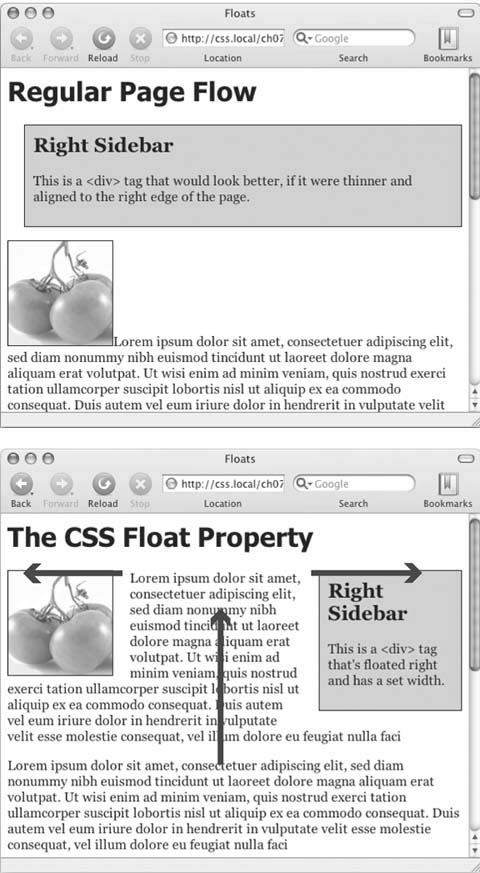
Figure 7-12. The regular flow of HTML is left to right, top to bottom, with one block-level element—headline, paragraph, <div>, and so on—stacked on top of the next. By letting you break up this uniformity, the float property is one of the most powerful and useful tools that CSS offers. Its uses range from simply moving an image to one side of a paragraph to providing complete layout control over banners, sidebars, navigation bars, and other page elements.
While you can use floats in some complex ( and confusing) ...
Read now
Unlock full access


 O’Reilly covers everything we've got, with content to help us build a world-class technology community, upgrade the capabilities and competencies of our teams, and improve overall team performance as well as their engagement.I wanted to learn C and C++, but it didn't click for me until I picked up an O'Reilly book. When I went on the O’Reilly platform, I was astonished to find all the books there, plus live events and sandboxes so you could play around with the technology.I’ve been on the O’Reilly platform for more than eight years. I use a couple of learning platforms, but I'm on O'Reilly more than anybody else. When you're there, you start learning. I'm never disappointed.I'm always learning. So when I got on to O'Reilly, I was like a kid in a candy store. There are playlists. There are answers. There's on-demand training. It's worth its weight in gold, in terms of what it allows me to do.