February 2000
Intermediate to advanced
464 pages
15h 57m
English
The most common failing that TCP has is related to the inability of a client to connect to a remote system. This can be caused by either the client specifying a destination port number that does not have a listening application associated with it (such as trying to connect to a nonexistent web server), or by the listening server refusing to accept a connection due to a configuration issue. Figure 7.44 shows what a session looks like when the specified destination does not have a listening application associated with it, while Figure 7.45 shows what a session looks like when the destination server refuses to accept the connection.
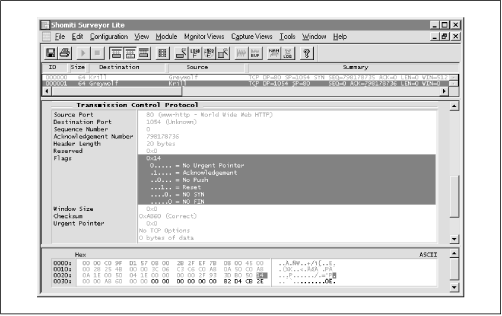
As stated, the most likely cause for this error is that the destination port number specified in the active open is not active. In the example shown in Figure 7.44, the destination port number of 80 (the well-known port number for HTTP) was inactive, meaning that no web server was available on the destination host.
Notice that the destination system’s TCP provider simply rejects the connection request. In the first segment, the client attempts to establish a connection, and the server responds with a Reset segment. This tells the client to just go away. The circuit never even gets established, with no Synchronize segment being returned.
Figure 7.45 shows what happens ...
Read now
Unlock full access


 O’Reilly covers everything we've got, with content to help us build a world-class technology community, upgrade the capabilities and competencies of our teams, and improve overall team performance as well as their engagement.I wanted to learn C and C++, but it didn't click for me until I picked up an O'Reilly book. When I went on the O’Reilly platform, I was astonished to find all the books there, plus live events and sandboxes so you could play around with the technology.I’ve been on the O’Reilly platform for more than eight years. I use a couple of learning platforms, but I'm on O'Reilly more than anybody else. When you're there, you start learning. I'm never disappointed.I'm always learning. So when I got on to O'Reilly, I was like a kid in a candy store. There are playlists. There are answers. There's on-demand training. It's worth its weight in gold, in terms of what it allows me to do.