September 2020
Beginner
442 pages
9h 54m
English
Data can be complicated; it’s not all just adding values together or counting things. For example, string data fields can have a lot of complexity, but using them is often essential in forming your data sets and analysis. Regular expressions (or regexes) are a set of commands that make parsing difficult strings much more achievable. In this chapter, we will cover what regexes are exactly, how they can be used in Prep Builder, and how to use some common regex functions.
Regular expressions are calculations that search for a pattern of characters (e.g., the value population) in a string of characters (e.g., "The population of the United Kingdom is 66,650,000 people"). Regexes are much more flexible in the patterns they can identify compared to the other string functions we’ve seen like LEFT(), MID(), and RIGHT().
One advantage of learning regexes is that they share a common set of commands across most data tools and therefore are highly transferable between data preparation tools. Another is how they can help you avoid building very complex string calculations using the simple string functions this book has covered thus far.
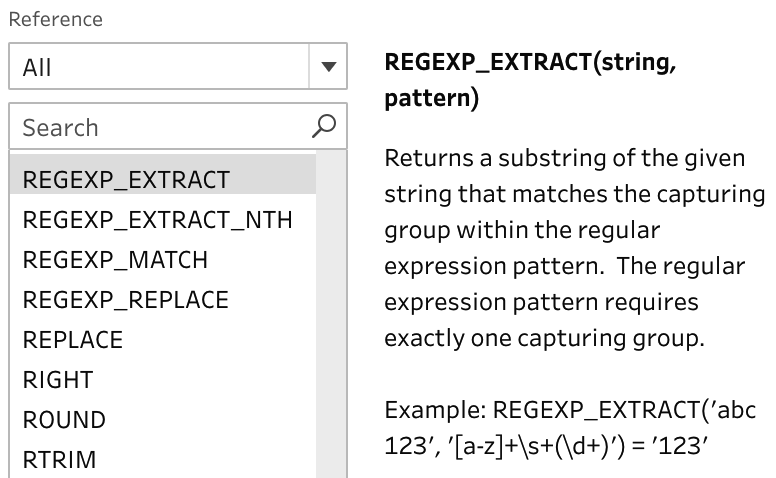
There are three main ways to use regexes in Prep (Figure 31-1).
To help you understand how to make use of regexes ...
Read now
Unlock full access


 O’Reilly covers everything we've got, with content to help us build a world-class technology community, upgrade the capabilities and competencies of our teams, and improve overall team performance as well as their engagement.I wanted to learn C and C++, but it didn't click for me until I picked up an O'Reilly book. When I went on the O’Reilly platform, I was astonished to find all the books there, plus live events and sandboxes so you could play around with the technology.I’ve been on the O’Reilly platform for more than eight years. I use a couple of learning platforms, but I'm on O'Reilly more than anybody else. When you're there, you start learning. I'm never disappointed.I'm always learning. So when I got on to O'Reilly, I was like a kid in a candy store. There are playlists. There are answers. There's on-demand training. It's worth its weight in gold, in terms of what it allows me to do.