July 2024
Intermediate to advanced
446 pages
12h 37m
English
For as long as software engineering has been a discipline, a great deal of care and attention have been given to application code and its architecture. All manner of paradigms, programming languages, and architectural patterns have originated to ensure that code is both well-organized in developers’ editors and running efficiently later in production. It took more than half a century to collectively realize that we hadn’t given enough thought to what happens in between.
Before the early 2000s, the average software product’s path to production was an error-prone and clunky journey full of repetitive manual tasks. On this journey, changes from individual contributors were often integrated with delays, artifacts were built by hand, configurations and dependencies were tweaked outside of version control, poorly documented deployment steps were executed in meticulous sequences…and let’s not forget testing, which was performed painstakingly by hand for every new version. As a result, release life cycles could span months or even years. Figure 1-1 is a fact-based depiction of those times.
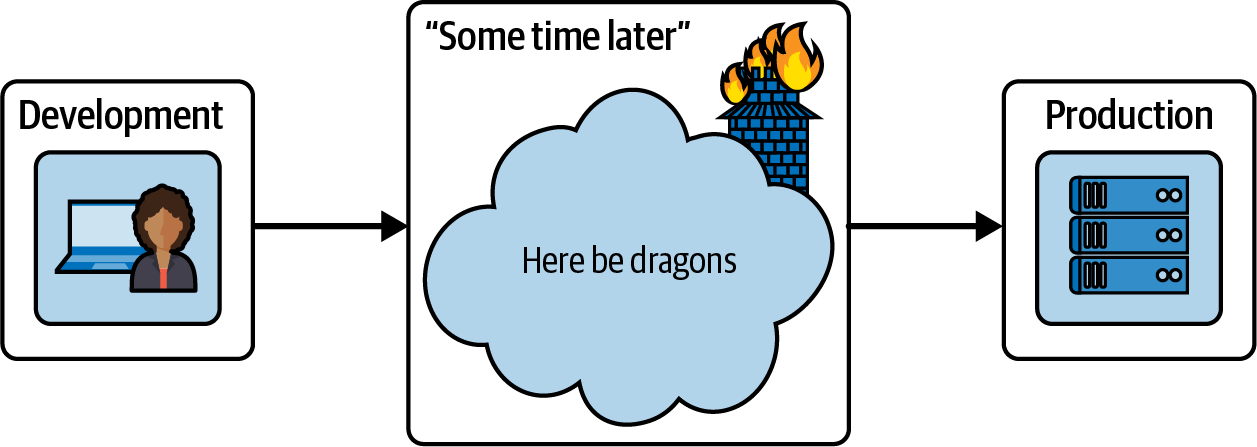
Such a lengthy path to production meant that all the up-front engineering investment in software design would not pay off until much later. Often, by the time new ...
Read now
Unlock full access


 O’Reilly covers everything we've got, with content to help us build a world-class technology community, upgrade the capabilities and competencies of our teams, and improve overall team performance as well as their engagement.I wanted to learn C and C++, but it didn't click for me until I picked up an O'Reilly book. When I went on the O’Reilly platform, I was astonished to find all the books there, plus live events and sandboxes so you could play around with the technology.I’ve been on the O’Reilly platform for more than eight years. I use a couple of learning platforms, but I'm on O'Reilly more than anybody else. When you're there, you start learning. I'm never disappointed.I'm always learning. So when I got on to O'Reilly, I was like a kid in a candy store. There are playlists. There are answers. There's on-demand training. It's worth its weight in gold, in terms of what it allows me to do.