March 2026
Intermediate
320 pages
7h 4m
English
In my work with executives and senior leaders, I consistently notice that they bring varying degrees of systems thinking to the table. It's visible almost immediately. Some leaders focus on narrow, immediate concerns, often getting stuck in details or reactive patterns. Others ask broad, connecting questions that span time horizons and organizational boundaries. This difference often determines not just how clearly leaders see the present but how effectively they lead into the future.
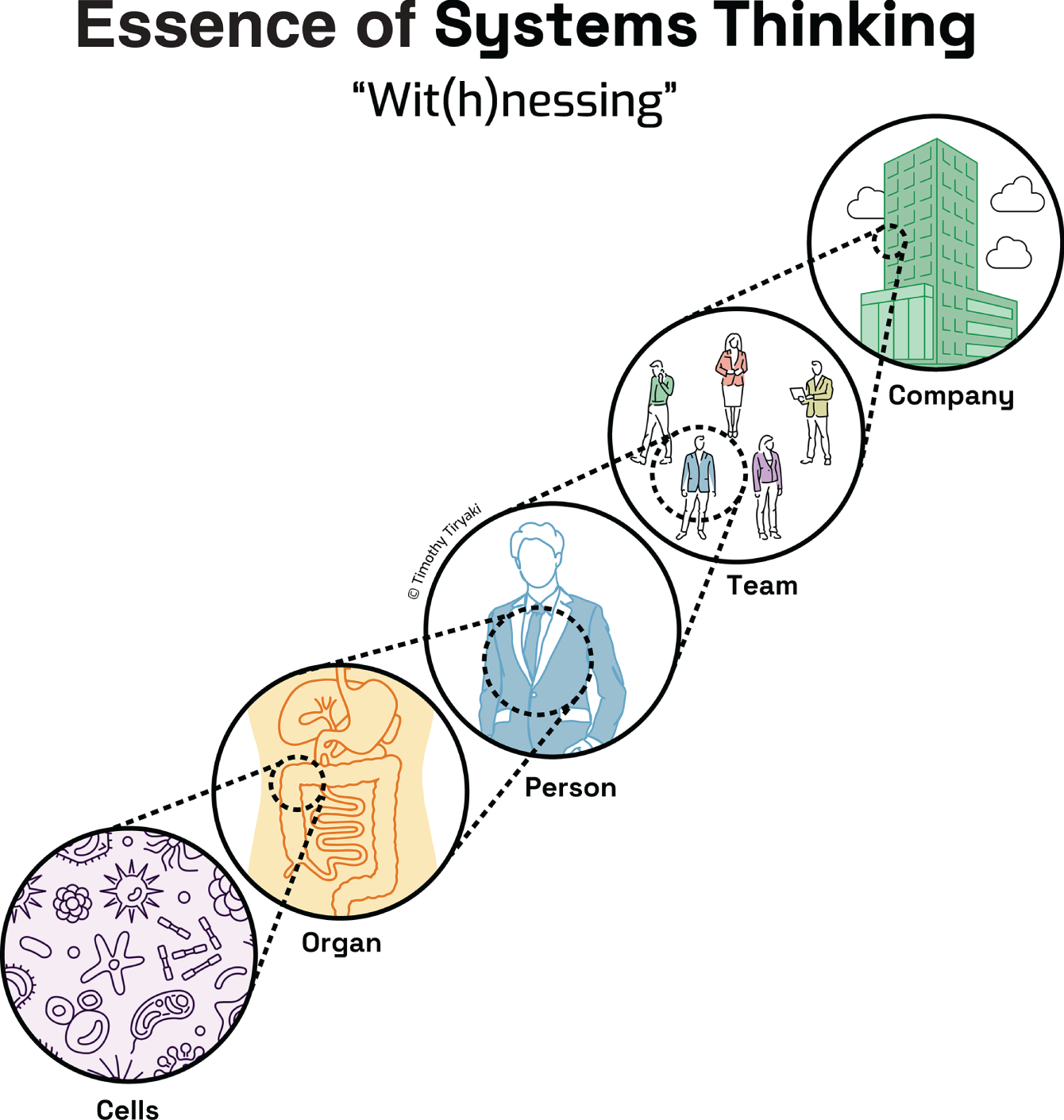
Peter Senge, in The Fifth Discipline, defines systems thinking as (Senge, 1990):
A discipline for seeing wholes. It is a framework for seeing interrelationships rather than things, for seeing patterns of change rather than static snapshots.
Donella Meadows, a pioneer in environmental systems thinking, writes in Thinking in Systems (Meadows, 2008):
A system is a set of things—people, cells, molecules, or whatever—interconnected in such a way that they produce their own pattern of behavior over time.
In my own words, systems thinking is the ability to sense and interpret the multiple layers and levels of a whole, recognizing not just what's happening on the surface but how things interact across time and space. It's about exploring how the parts relate to one another, how feedback loops shape ...
Read now
Unlock full access


 O’Reilly covers everything we've got, with content to help us build a world-class technology community, upgrade the capabilities and competencies of our teams, and improve overall team performance as well as their engagement.I wanted to learn C and C++, but it didn't click for me until I picked up an O'Reilly book. When I went on the O’Reilly platform, I was astonished to find all the books there, plus live events and sandboxes so you could play around with the technology.I’ve been on the O’Reilly platform for more than eight years. I use a couple of learning platforms, but I'm on O'Reilly more than anybody else. When you're there, you start learning. I'm never disappointed.I'm always learning. So when I got on to O'Reilly, I was like a kid in a candy store. There are playlists. There are answers. There's on-demand training. It's worth its weight in gold, in terms of what it allows me to do.