June 2023
Intermediate to advanced
400 pages
7h 34m
English
Chaos in the midst of chaos isn't funny, but chaos in the midst of order is.
—Steve Martin
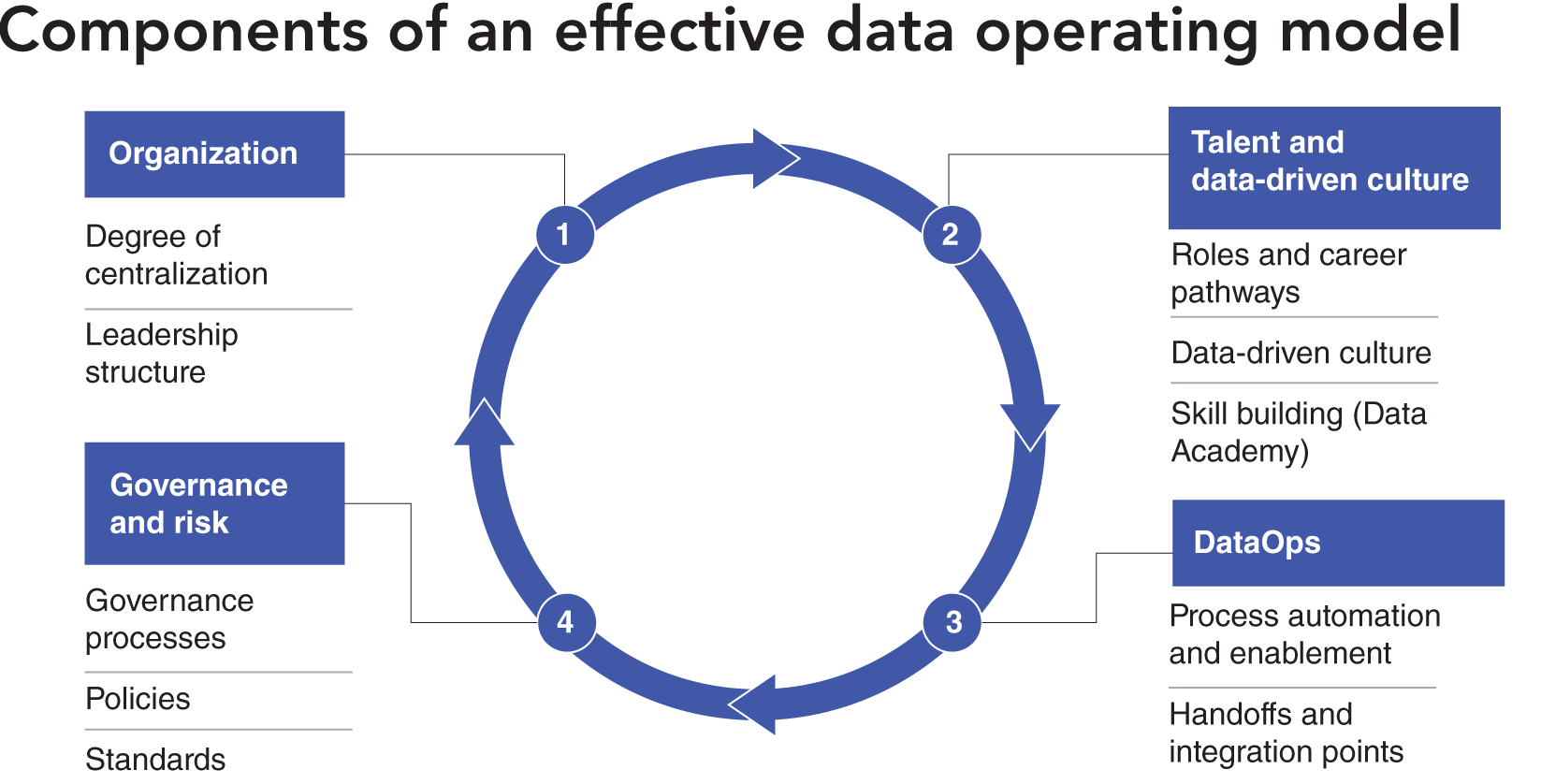
The data operating model is the overall approach for how the organization should manage data. It has four primary components: organization, talent and culture, tooling and DataOps, and governance and risk (see Exhibit 27.1).
Some companies worry that building up this capability can seem like developing another bureaucracy or is perhaps only relevant to large banks. But in our experience, getting this data governance and operating model right is absolutely pivotal to becoming a data-intensive enterprise. It's easy to neglect having a strong operating model when you're dealing with one or two data use cases since you can often get away without it. But getting value from hundreds if not thousands of use cases is simply impossible without an effective and well-organized operating model. By developing clarity in these areas, companies can avoid the conflicts, confusion, and delays that typically hamper efforts around data.1
Many companies struggle with how they should organize for effective data management and analytics. Who should own data? Should we have a data organization? How should it link with the business? And with IT? Who should own data engineering? Should data privacy and compliance be separated? ...
Read now
Unlock full access


 O’Reilly covers everything we've got, with content to help us build a world-class technology community, upgrade the capabilities and competencies of our teams, and improve overall team performance as well as their engagement.I wanted to learn C and C++, but it didn't click for me until I picked up an O'Reilly book. When I went on the O’Reilly platform, I was astonished to find all the books there, plus live events and sandboxes so you could play around with the technology.I’ve been on the O’Reilly platform for more than eight years. I use a couple of learning platforms, but I'm on O'Reilly more than anybody else. When you're there, you start learning. I'm never disappointed.I'm always learning. So when I got on to O'Reilly, I was like a kid in a candy store. There are playlists. There are answers. There's on-demand training. It's worth its weight in gold, in terms of what it allows me to do.