May 2005
Beginner to intermediate
398 pages
12h 12m
English
Many processors implement one or more stacks , which serve as temporary storage in external memory. The processor can push a value from a register on the stack to preserve it for later use. The processor retrieves this value by popping from the stack back into a register. In some processor architectures, popping is also known as pulling.
Most processors have a special register known as a stack pointer , which references the next free location on the stack. Some processors implement more than one stack and so have more than one stack pointer. Most stacks grow down through memory. (Some processors have stacks that grow up as the stack is filled.) When the processor pushes or pops a value to or from the stack, the stack pointer automatically decrements or increments to point to the next free location.
Figure 2-3 shows the steps that occur when the content of a register (in this case, 72) is pushed onto the stack. These steps are normally performed by a single instruction (for example, PSHA). First, the value is copied from the register and stored to the location pointed to by the stack pointer. The stack pointer is then decremented. Again, these operations take place automatically by executing a single push instruction.
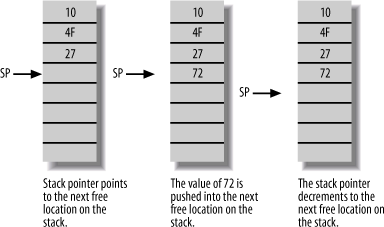
Figure 2-3. Pushing a register onto the stack
Most processors automatically save registers to the stack when events such as interrupts occur. However, the stack ...
Read now
Unlock full access


 O’Reilly covers everything we've got, with content to help us build a world-class technology community, upgrade the capabilities and competencies of our teams, and improve overall team performance as well as their engagement.I wanted to learn C and C++, but it didn't click for me until I picked up an O'Reilly book. When I went on the O’Reilly platform, I was astonished to find all the books there, plus live events and sandboxes so you could play around with the technology.I’ve been on the O’Reilly platform for more than eight years. I use a couple of learning platforms, but I'm on O'Reilly more than anybody else. When you're there, you start learning. I'm never disappointed.I'm always learning. So when I got on to O'Reilly, I was like a kid in a candy store. There are playlists. There are answers. There's on-demand training. It's worth its weight in gold, in terms of what it allows me to do.