May 2005
Beginner to intermediate
398 pages
12h 12m
English
We'll start with something simple: a temperature sensor. This little sensor has a wide range of applications. The most obvious is as an environment monitor or weather station, but you could also use it to sense temperatures inside rooms and to control the appropriate heating or cooling systems. Combine it with a datalogger design, and you have a temperature recorder. Such devices are used in the shipment of fruits, vegetables, frozen foods, and flowers to ensure that they get to market in their best condition. It can also be used in the shipment of blood products and pathology samples, making sure that these critical substances are not exposed to adverse temperatures.
The AD22100 and AD22103 temperature sensors, by Analog Devices, are very easy to use. They are 3-pin devices,[*] requiring only power (V S) and ground to give you a voltage output that is proportional to temperature (Figure 13-11). The AD22100 requires a 5 V supply, and the AD22103 requires a 3.3 V supply.
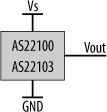
Figure 13-11. AD22100/AD22103
What could be easier than that?
The output voltage corresponds to 22.5 mV/ºC over the temperature range -50ºC to +150ºC for the AD22100 and 28 mV/ºC over the temperature range 0ºC to 100ºC for the AD22103. The transfer functions (how the output relates to the input) for the two devices are given by:
    VOUT = (VS / 5) x [1.375 + (0.0225 x TA)]            AD22100
VOUT = (VS / 3.3) ...Read now
Unlock full access


 O’Reilly covers everything we've got, with content to help us build a world-class technology community, upgrade the capabilities and competencies of our teams, and improve overall team performance as well as their engagement.I wanted to learn C and C++, but it didn't click for me until I picked up an O'Reilly book. When I went on the O’Reilly platform, I was astonished to find all the books there, plus live events and sandboxes so you could play around with the technology.I’ve been on the O’Reilly platform for more than eight years. I use a couple of learning platforms, but I'm on O'Reilly more than anybody else. When you're there, you start learning. I'm never disappointed.I'm always learning. So when I got on to O'Reilly, I was like a kid in a candy store. There are playlists. There are answers. There's on-demand training. It's worth its weight in gold, in terms of what it allows me to do.