March 2015
Beginner to intermediate
840 pages
25h 12m
English
We provide an overview of vector calculus statements used throughout Chapter 9. For a detailed treatment of the subject the reader is referred to specialized texts in electromagnetic field theory such as Balanis (1989) or mathematics handbooks like Korn and Korn (1968).
In order to characterize scalar and vector fields, we introduce coordinate systems. A general treatment of orthogonal coordinates can be found in Morse and Feshbach (1953). The three coordinate systems used most often are Cartesian, cylindrical, and spherical. Cartesian coordinates are illustrated in Figure D.1.
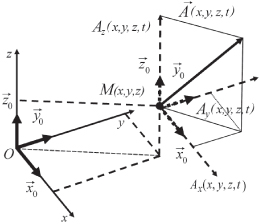
Figure D.1 Vectors representation in Cartesian coordinates.
Here one has three orthogonal axes —  , and
, and  — with origin O. A standard basis of three unit vectors corresponding to those axes is designated as (
 ). Let vector
  be measured by a sensor located at point M with coordinates . To expand the vector into a sum of Cartesian projections one first moves the basis ...
Read now
Unlock full access


 O’Reilly covers everything we've got, with content to help us build a world-class technology community, upgrade the capabilities and competencies of our teams, and improve overall team performance as well as their engagement.I wanted to learn C and C++, but it didn't click for me until I picked up an O'Reilly book. When I went on the O’Reilly platform, I was astonished to find all the books there, plus live events and sandboxes so you could play around with the technology.I’ve been on the O’Reilly platform for more than eight years. I use a couple of learning platforms, but I'm on O'Reilly more than anybody else. When you're there, you start learning. I'm never disappointed.I'm always learning. So when I got on to O'Reilly, I was like a kid in a candy store. There are playlists. There are answers. There's on-demand training. It's worth its weight in gold, in terms of what it allows me to do.