April 2013
Intermediate to advanced
1164 pages
39h 37m
English
Abundance-constrained linear spectral mixture analysis (AC-LSMA) using LSE as a criterion has been studied extensively in the literature. It is, in general, referred to as least-squares AC-LSMA. However, including a weighting matrix in the least-squares AC-LSMA to account for significance of individual bands has not been explored in the past few years until Chang and Ji, (2006a). This chapter investigates weighted AC-LSMA in terms of LSE and further develops three approaches to weighted AC-LSMA, each of which can be obtained by the commonly used criteria, Mahalanobis distance or Gaussian maximum likelihood estimation, Fisher's ratio, and OSP. In particular, the least-squares AC-LSMA can be considered an unweighted AC-LSMA. The experimental results demonstrate that weighted AC-LSMA generally performs better than unweighted AC-LSMA.
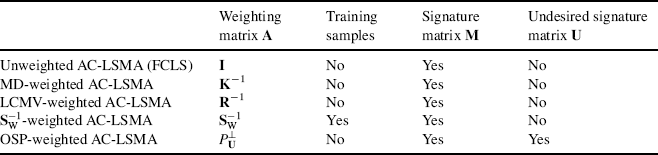
Finally, we summarize the advantages and disadvantages of the unweighted AC-LSMA (i.e., FCLS), along with all the four weighted AC-LSMA methods considered in Table 14.6 in this chapter.
Table 14.6 Summary of unweighted AC-LSMA (FCLS) and four weighted AC-LSMA methods.
Read now
Unlock full access


 O’Reilly covers everything we've got, with content to help us build a world-class technology community, upgrade the capabilities and competencies of our teams, and improve overall team performance as well as their engagement.I wanted to learn C and C++, but it didn't click for me until I picked up an O'Reilly book. When I went on the O’Reilly platform, I was astonished to find all the books there, plus live events and sandboxes so you could play around with the technology.I’ve been on the O’Reilly platform for more than eight years. I use a couple of learning platforms, but I'm on O'Reilly more than anybody else. When you're there, you start learning. I'm never disappointed.I'm always learning. So when I got on to O'Reilly, I was like a kid in a candy store. There are playlists. There are answers. There's on-demand training. It's worth its weight in gold, in terms of what it allows me to do.