March 2005
Beginner
400 pages
11h 49m
English
Let’s say you snap a near-perfect family portrait: the focus is sharp, the composition is balanced, everyone’s smiling. And then you notice it: Uncle Mitch, standing dead center in the picture, looks like a vampire bat. His eyes are glowing red, as though illuminated by the evil within.
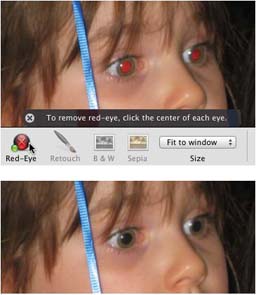
Figure 6-5. Top: When you click the Red-Eye tool, a pop-up message informs you of the next step: Click carefully inside each affected eye.Bottom: Truth be told, the Red-Eye tool doesn’t know an eyeball from a pinkie toe. It just turns any red pixels black, regardless of what body part they’re associated with. Friends and family members look more attractive—and less like Star Trek characters—after you touch up their phosphorescent red eyes with iPhoto.
You’ve been victimized by red-eye, a common problem in flash photography. This creepy possessed-by-aliens look has ruined many an otherwise-great photo.
Red-eye is actually light reflected back from your subject’s eyes. The bright light of your camera’s flash passes through the pupil of each eye, illuminating the blood-red retinal tissue at the back of the eye. This illuminated tissue, in turn, is reflected back into the camera lens. Red-eye problems worsen when you shoot pictures in a dim room, because your subject’s pupils are dilated wider, allowing even more light from the flash to illuminate the retina.
Page 62 offers advice on avoiding red-eye ...
Read now
Unlock full access


 O’Reilly covers everything we've got, with content to help us build a world-class technology community, upgrade the capabilities and competencies of our teams, and improve overall team performance as well as their engagement.I wanted to learn C and C++, but it didn't click for me until I picked up an O'Reilly book. When I went on the O’Reilly platform, I was astonished to find all the books there, plus live events and sandboxes so you could play around with the technology.I’ve been on the O’Reilly platform for more than eight years. I use a couple of learning platforms, but I'm on O'Reilly more than anybody else. When you're there, you start learning. I'm never disappointed.I'm always learning. So when I got on to O'Reilly, I was like a kid in a candy store. There are playlists. There are answers. There's on-demand training. It's worth its weight in gold, in terms of what it allows me to do.