August 2012
Beginner
583 pages
16h 1m
English
There are a number of different style types, ranging from the default styles set up by your browser (and any user styles you may have applied in your browser to override its defaults), through inline or embedded styles, to external style sheets. The styles defined have a hierarchy of precedence, from low to high.
The styling with the lowest level of precedence is the default styling applied by a web browser. These styles are created as a fallback for when a web page doesn’t have any styles defined; they are intended to be a generic set of styles that will display reasonably well in most instances.
Pre-CSS these were the only styles applied to a document, and only a handful of them could be changed by a web page (such as font face, color, and size, plus a few element sizing arguments).
User-defined styles have the next-highest precedence; they are supported by most modern browsers but are implemented differently by each. If you would like to learn how to create your own default styles for browsing, use a search engine to enter your browser name followed by “user styles” (for example, “Firefox user styles” or “IE user styles”). Figure 18-2 shows a user style sheet being applied to Microsoft Internet Explorer.
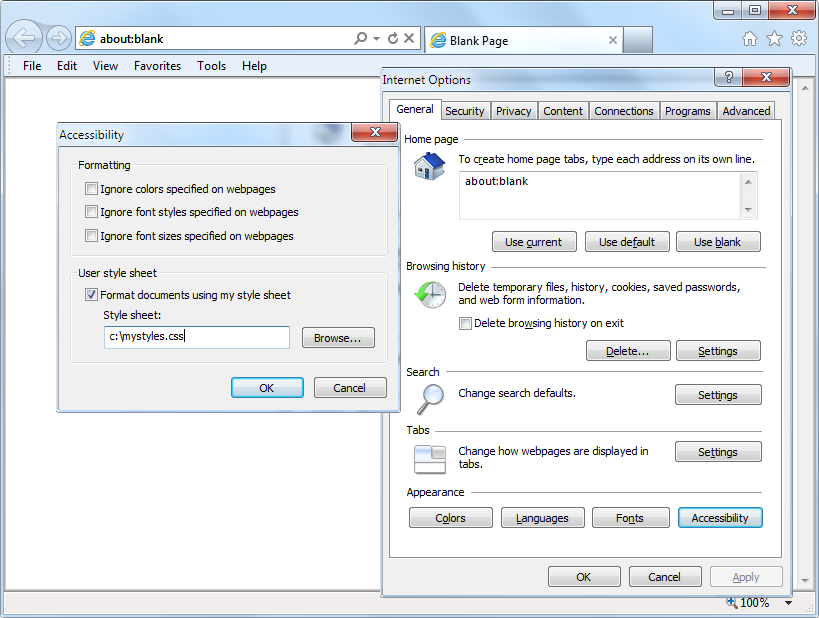
If a user style is assigned that has already been defined as a browser default, it will ...
Read now
Unlock full access


 O’Reilly covers everything we've got, with content to help us build a world-class technology community, upgrade the capabilities and competencies of our teams, and improve overall team performance as well as their engagement.I wanted to learn C and C++, but it didn't click for me until I picked up an O'Reilly book. When I went on the O’Reilly platform, I was astonished to find all the books there, plus live events and sandboxes so you could play around with the technology.I’ve been on the O’Reilly platform for more than eight years. I use a couple of learning platforms, but I'm on O'Reilly more than anybody else. When you're there, you start learning. I'm never disappointed.I'm always learning. So when I got on to O'Reilly, I was like a kid in a candy store. There are playlists. There are answers. There's on-demand training. It's worth its weight in gold, in terms of what it allows me to do.