April 2026
Intermediate
400 pages
9h 26m
English
Trust is a fundamental element not only when managing complex projects but in overall relationships between people. It is the basis upon which effective communication, collaboration, and decision‐making are built. In the context of project management, trust can be defined as the stakeholder's openness to depend on the actions of others based on the understanding that things will be done independently of the ability to check or control that other party (Mayer, Davis, and Schoorman 1995).
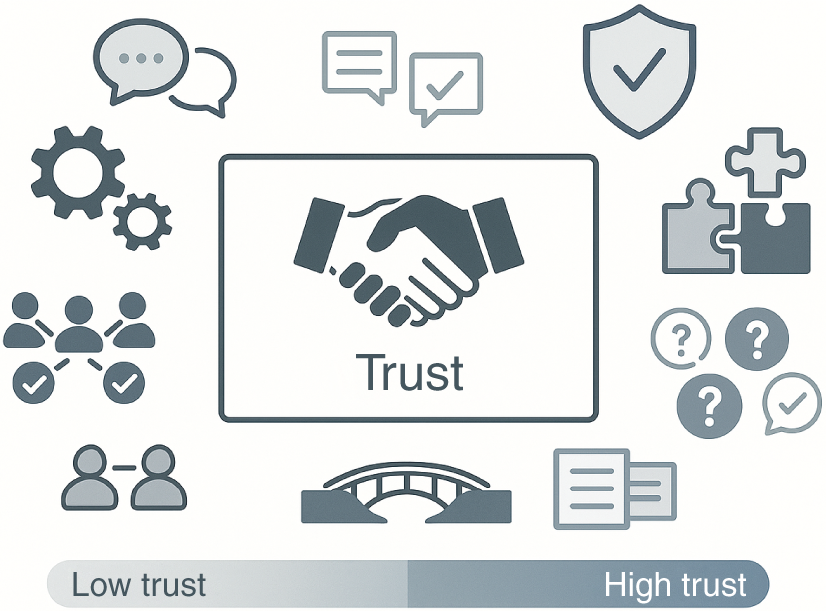
The degree of trust in a project environment refers to confidence and reliance between various project stakeholders, including the project manager, team members, sponsors, managers, clients, and external partners. This trust dimension is particularly significant in complex projects with high uncertainty, interdependencies, and the potential for emergent behaviors.
Müller and Geraldi (2007) argue that the more trust among project stakeholders, the lower the project's complexity. This inverse relationship between trust and complexity emphasizes trust's critical role in reducing project complexity. When trust is high, stakeholders are more likely to share information openly, collaborate effectively, and work toward common goals, thereby reducing the overall complexity of the project.
Read now
Unlock full access


 O’Reilly covers everything we've got, with content to help us build a world-class technology community, upgrade the capabilities and competencies of our teams, and improve overall team performance as well as their engagement.I wanted to learn C and C++, but it didn't click for me until I picked up an O'Reilly book. When I went on the O’Reilly platform, I was astonished to find all the books there, plus live events and sandboxes so you could play around with the technology.I’ve been on the O’Reilly platform for more than eight years. I use a couple of learning platforms, but I'm on O'Reilly more than anybody else. When you're there, you start learning. I'm never disappointed.I'm always learning. So when I got on to O'Reilly, I was like a kid in a candy store. There are playlists. There are answers. There's on-demand training. It's worth its weight in gold, in terms of what it allows me to do.