April 2026
Intermediate
400 pages
9h 26m
English
Risk is a critical dimension in complex project management that significantly influences project outcomes and decision‐making processes. While risk and uncertainty are closely related concepts, it is important to distinguish between them. A risk has both a probability of occurrence and a degree of impact should it materialize. In contrast, uncertainty refers to an absence of knowledge or information about potential future events or outcomes (Levin and Ward 2011).
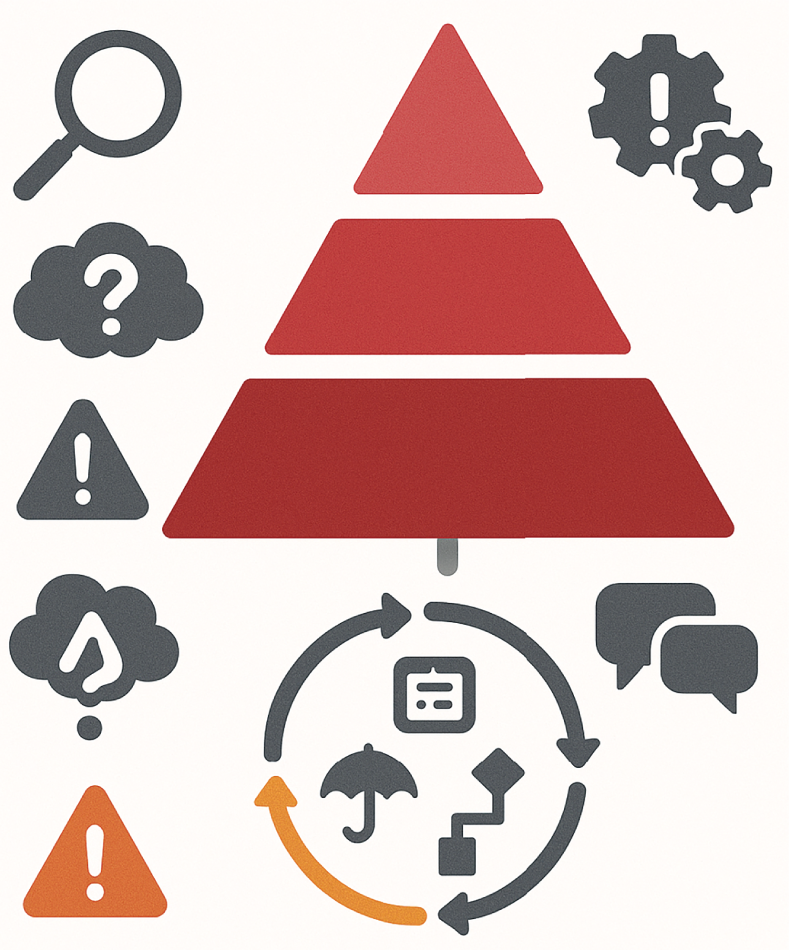
The risk dimension in project complexity relates explicitly to the extent of unknown risks present in a project and their potential impacts on the management process and final product delivery. These unknowns can be categorized as “known‐unknowns” (risks that are identified but whose impacts are uncertain) and “unknown‐unknowns” (risks that have not yet been identified or anticipated) (Kerzner and Belack 2010). Risk management in projects involves implementing processes aimed at reducing the impact and/or probability of negative risks (threats) while maximizing the impact and/or probability of positive risks (opportunities) (Shenhar and Dvir 2007).
The effectiveness of risk management can significantly influence a project's complexity level. The risk dimension can be categorized into four levels of increasing complexity:
Read now
Unlock full access


 O’Reilly covers everything we've got, with content to help us build a world-class technology community, upgrade the capabilities and competencies of our teams, and improve overall team performance as well as their engagement.I wanted to learn C and C++, but it didn't click for me until I picked up an O'Reilly book. When I went on the O’Reilly platform, I was astonished to find all the books there, plus live events and sandboxes so you could play around with the technology.I’ve been on the O’Reilly platform for more than eight years. I use a couple of learning platforms, but I'm on O'Reilly more than anybody else. When you're there, you start learning. I'm never disappointed.I'm always learning. So when I got on to O'Reilly, I was like a kid in a candy store. There are playlists. There are answers. There's on-demand training. It's worth its weight in gold, in terms of what it allows me to do.