July 2011
Intermediate to advanced
240 pages
6h 37m
English
Strategic Alignment Model
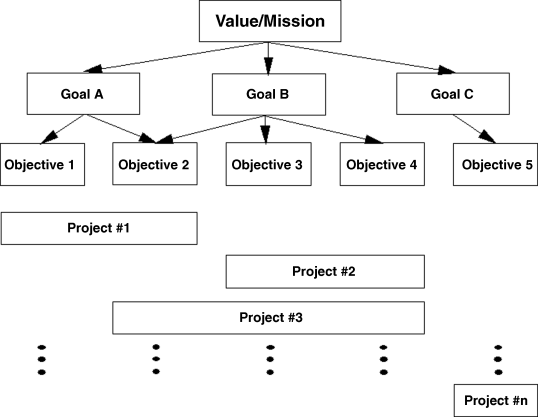
While this model can be used at the business unit level its best use is at the organizational level. The Strategic Alignment Model makes good sense because it attempts to align projects at all levels of the organization with the goals the organization has decided to pursue. In other words, it aligns projects with the things that are important to the organization. Figure 9.3 graphically depicts this model.
Figure 9.3 Strategic Alignment Model
Value/Mission
The value/mission is a very brief statement of why the enterprise exists. This could define an end state that the organization hopes to achieve or simply be a statement of how the organization views the business it is in. Whichever form is used, this statement is unlikely to change, at least not in the foreseeable future.
Goals
To achieve its end state or accomplish its mission, the organization has to engage in certain major efforts. These are likely to be multi-period or multi-year efforts designed to accomplish major results. These goals might define an ideal end state that is never attainable (eliminating world hunger, for example), or they might be achievable over long periods of time (finding a cure for cancer or a preventative program for the common cold, for example). Any of these are good examples of goal statements. The important thing to remember is that they must be each stated in a way that ...
Read now
Unlock full access


 O’Reilly covers everything we've got, with content to help us build a world-class technology community, upgrade the capabilities and competencies of our teams, and improve overall team performance as well as their engagement.I wanted to learn C and C++, but it didn't click for me until I picked up an O'Reilly book. When I went on the O’Reilly platform, I was astonished to find all the books there, plus live events and sandboxes so you could play around with the technology.I’ve been on the O’Reilly platform for more than eight years. I use a couple of learning platforms, but I'm on O'Reilly more than anybody else. When you're there, you start learning. I'm never disappointed.I'm always learning. So when I got on to O'Reilly, I was like a kid in a candy store. There are playlists. There are answers. There's on-demand training. It's worth its weight in gold, in terms of what it allows me to do.