July 2026
Intermediate
480 pages
20h 9m
English
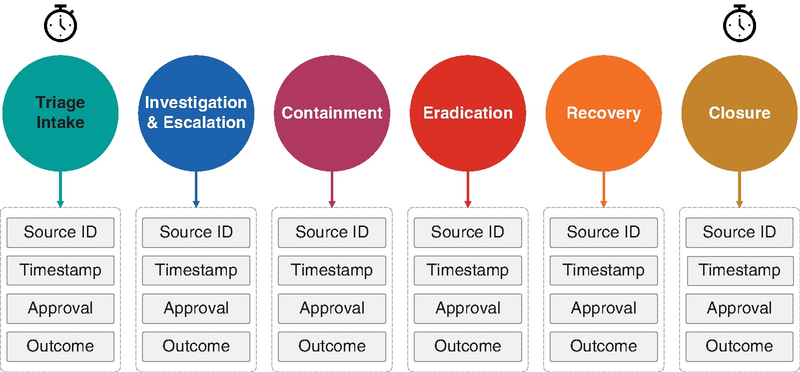
Incident response (IR) and crisis management form the true test of an organization’s cybersecurity maturity. Technical controls may detect threats, but the ability to coordinate people, processes, and evidence under pressure determines whether damage is contained or magnified. This chapter examines how structured response models, disciplined documentation, and accountable decision-making transform chaos into control. By aligning incident operations with governance, risk, and compliance expectations, it demonstrates how auditors evaluate readiness not only through procedures on paper but through the traceability of every decision, action, and communication.
Effective IR is inseparable from business continuity and legal defensibility. The ability to preserve forensic integrity, meet disclosure obligations, and restore systems within defined recovery objectives is both a technical and regulatory imperative. Understanding how evidence flows—from detection and triage through containment, forensics, recovery, and lessons learned—reveals the interconnected nature of modern security architecture. Each function, from communications governance to backup readiness, becomes a point of audit assurance linking operational resilience to enterprise accountability.
As artificial intelligence, automation, and cloud orchestration accelerate response ...
Read now
Unlock full access


 O’Reilly covers everything we've got, with content to help us build a world-class technology community, upgrade the capabilities and competencies of our teams, and improve overall team performance as well as their engagement.I wanted to learn C and C++, but it didn't click for me until I picked up an O'Reilly book. When I went on the O’Reilly platform, I was astonished to find all the books there, plus live events and sandboxes so you could play around with the technology.I’ve been on the O’Reilly platform for more than eight years. I use a couple of learning platforms, but I'm on O'Reilly more than anybody else. When you're there, you start learning. I'm never disappointed.I'm always learning. So when I got on to O'Reilly, I was like a kid in a candy store. There are playlists. There are answers. There's on-demand training. It's worth its weight in gold, in terms of what it allows me to do.