July 2026
Intermediate
480 pages
20h 9m
English
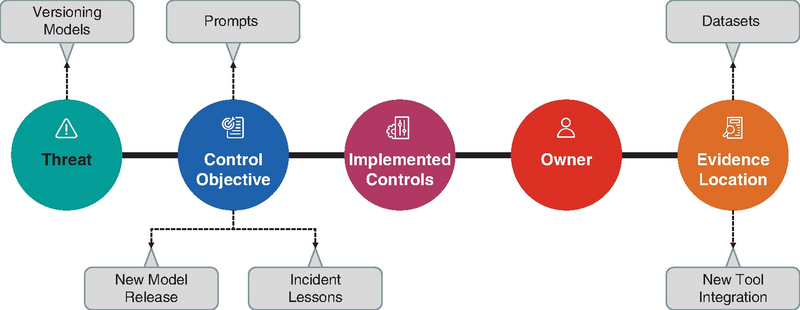
Artificial intelligence (AI) has redefined how organizations operate, but it has also reshaped how auditors must think about assurance, control, and accountability. The velocity of AI adoption—spanning models, datasets, prompts, and automated agents—demands a disciplined approach to understanding where risks emerge and how they can be mitigated within auditable boundaries. This chapter positions the auditor at the intersection of automation, analytics, and adaptive systems, equipping them to evaluate AI not as a black box but as an integrated, evolving ecosystem. Understanding this ecosystem is essential to maintaining trust, transparency, and regulatory compliance in environments where decisions are increasingly delegated to machine-driven logic.
From threat modeling to control design, AI auditing extends traditional assurance practices into domains where data, logic, and behavior are constantly in flux. This chapter examines how familiar frameworks can be adapted to map AI-specific attack surfaces—prompt injections, data poisoning, model theft, and misuse through integrations—and how these threats translate into measurable control objectives across identity, data protection, and behavioral safety. By emphasizing data integrity, traceability, and governance, it establishes a foundation for evidence-driven assurance that can withstand ...
Read now
Unlock full access


 O’Reilly covers everything we've got, with content to help us build a world-class technology community, upgrade the capabilities and competencies of our teams, and improve overall team performance as well as their engagement.I wanted to learn C and C++, but it didn't click for me until I picked up an O'Reilly book. When I went on the O’Reilly platform, I was astonished to find all the books there, plus live events and sandboxes so you could play around with the technology.I’ve been on the O’Reilly platform for more than eight years. I use a couple of learning platforms, but I'm on O'Reilly more than anybody else. When you're there, you start learning. I'm never disappointed.I'm always learning. So when I got on to O'Reilly, I was like a kid in a candy store. There are playlists. There are answers. There's on-demand training. It's worth its weight in gold, in terms of what it allows me to do.