September 2002
Intermediate to advanced
656 pages
22h 14m
English
Caches also can reduce network bottlenecks. Many networks provide more bandwidth to local network clients than to remote servers (Figure 7-1). Clients access servers at the speed of the slowest network on the way. If a client gets a copy from a cache on a fast LAN, caching can boost performance—especially for larger documents.
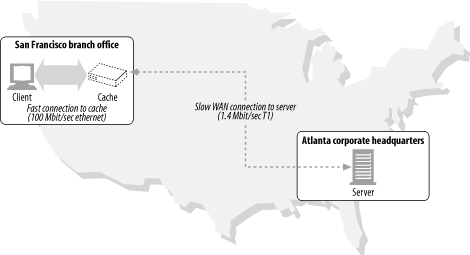
Figure 7-1. Limited wide area bandwidth creates a bottleneck that caches can improve
In Figure 7-1, it might take 30 seconds for a user in the San Francisco branch of Joe’s Hardware, Inc. to download a 5-MB inventory file from the Atlanta headquarters, across the 1.4-Mbps T1 Internet connection. If the document was cached in the San Francisco office, a local user might be able to get the same document in less than a second across the Ethernet connection.
Table 7-1 shows how bandwidth affects transfer time for a few different network speeds and a few different sizes of documents. Bandwidth causes noticeable delays for larger documents, and the speed difference between different network types is dramatic.[1] A 56-Kbps modem would take 749 seconds (over 12 minutes) to transfer a 5-MB file that could be transported in under a second across a fast Ethernet LAN.
Table 7-1. Bandwidth-imposed transfer time delays, idealized (time in seconds)
|
Large HTML (15 KB) |
JPEG (40 KB) |
Large JPEG (150 KB) |
Large file (5 MB) | |
|---|---|---|---|---|
|
Dialup modem (56 Kbit/sec) |
Read now
Unlock full access


 O’Reilly covers everything we've got, with content to help us build a world-class technology community, upgrade the capabilities and competencies of our teams, and improve overall team performance as well as their engagement.I wanted to learn C and C++, but it didn't click for me until I picked up an O'Reilly book. When I went on the O’Reilly platform, I was astonished to find all the books there, plus live events and sandboxes so you could play around with the technology.I’ve been on the O’Reilly platform for more than eight years. I use a couple of learning platforms, but I'm on O'Reilly more than anybody else. When you're there, you start learning. I'm never disappointed.I'm always learning. So when I got on to O'Reilly, I was like a kid in a candy store. There are playlists. There are answers. There's on-demand training. It's worth its weight in gold, in terms of what it allows me to do.