September 2002
Intermediate to advanced
656 pages
22h 14m
English
Even if bandwidth isn’t a problem, distance might be. Every network router adds delays to Internet traffic. And even if there are not many routers between client and server, the speed of light alone can cause a significant delay.
The direct distance from Boston to San Francisco is about 2,700 miles. In the very best case, at the speed of light (186,000 miles/sec), a signal could travel from Boston to San Francisco in about 15 milliseconds and complete a round trip in 30 milliseconds.[2]
Say a web page contains 20 small images, all located on a server in San Francisco. If a client in Boston opens four parallel connections to the server, and keeps the connections alive, the speed of light alone contributes almost 1/4 second (240 msec) to the download time (Figure 7-3). If the server is in Tokyo (6,700 miles from Boston), the delay grows to 600 msec. Moderately complicated web pages can incur several seconds of speed-of-light delays.
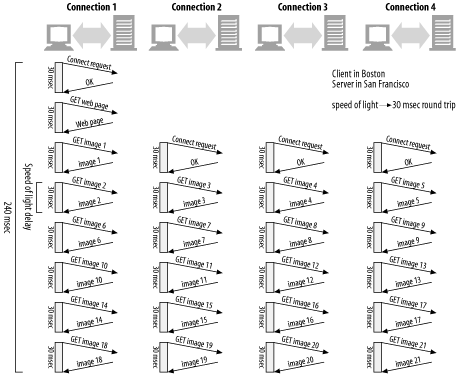
Figure 7-3. Speed of light can cause significant delays, even with parallel, keep-alive connections
Placing caches in nearby machine rooms can shrink document travel distance from thousands of miles to tens of yards.
[2] In reality, signals travel at somewhat less than the speed of light, so distance delays are even worse.
Read now
Unlock full access


 O’Reilly covers everything we've got, with content to help us build a world-class technology community, upgrade the capabilities and competencies of our teams, and improve overall team performance as well as their engagement.I wanted to learn C and C++, but it didn't click for me until I picked up an O'Reilly book. When I went on the O’Reilly platform, I was astonished to find all the books there, plus live events and sandboxes so you could play around with the technology.I’ve been on the O’Reilly platform for more than eight years. I use a couple of learning platforms, but I'm on O'Reilly more than anybody else. When you're there, you start learning. I'm never disappointed.I'm always learning. So when I got on to O'Reilly, I was like a kid in a candy store. There are playlists. There are answers. There's on-demand training. It's worth its weight in gold, in terms of what it allows me to do.