August 2007
Beginner
416 pages
12h 16m
English
A recent addition to navigation mechanisms is the tag cloud, which lists links alphabetically and weighted by frequency; the more frequently occurring a topic the larger it appears. This gives a snapshot into the relative significance of a topic: the larger the link, the more important it is. Although most often implemented with tags (hence the name), these mechanisms sometimes employ other types of links as well.
Tag clouds are good for dynamic content. Flickr is reported to be the first site to use the tag cloud (www.flickr.com, Figure 3-20).[48] Tags that are used more frequently are displayed in a larger font, so the cloud shows popularity of tags. (See Chapter 12 for more on tagging).
As a navigational mechanism, tag clouds have limited value. If a visitor has a known information need, for instance, a cloud of links isn't really efficient. They seem to be more of a novelty than an effective navigation mechanism. But the visual weighting of links provides valuable information: it shows at a glance what others are talking about or about the concerns of a community. Tag clouds reflect a certain zeitgeist for a site or topic.
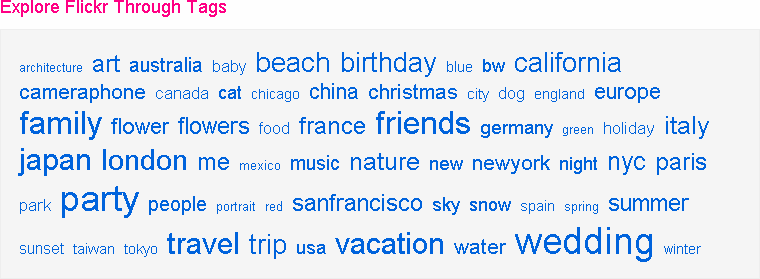
Figure 3-20. Flickr's famous tag cloud
[48] See "Tag cloud" on Wikipedia: en.wikipedia.org/wiki/Tag_cloud.
Read now
Unlock full access


 O’Reilly covers everything we've got, with content to help us build a world-class technology community, upgrade the capabilities and competencies of our teams, and improve overall team performance as well as their engagement.I wanted to learn C and C++, but it didn't click for me until I picked up an O'Reilly book. When I went on the O’Reilly platform, I was astonished to find all the books there, plus live events and sandboxes so you could play around with the technology.I’ve been on the O’Reilly platform for more than eight years. I use a couple of learning platforms, but I'm on O'Reilly more than anybody else. When you're there, you start learning. I'm never disappointed.I'm always learning. So when I got on to O'Reilly, I was like a kid in a candy store. There are playlists. There are answers. There's on-demand training. It's worth its weight in gold, in terms of what it allows me to do.