August 2007
Beginner
416 pages
12h 16m
English
Jacob Nielsen claims that CNET.com was the first to make extensive, consistent use of a navigation mechanism (a stack of links on the screen's left) across an entire site. Called a vertical or left-hand menu (or right-hand menu if on the right), this vertical arrangement has become prevalent in web navigation design.
Vertical menus are generally more flexible than navigation bars or tabs. Because the mechanism can easily extend downward, adding options is usually not as problematic as adding a tab. Additionally, vertical menus generally allow for longer labels, particularly if they can wrap onto two or more lines.
The Oracle web site uses a vertical menu with long, descriptive labels on the left of its home page to provide access to the major areas of the site (www.oracle.com, Figure 3-31). In a horizontal navigation bar, many of these labels would have to be shortened.
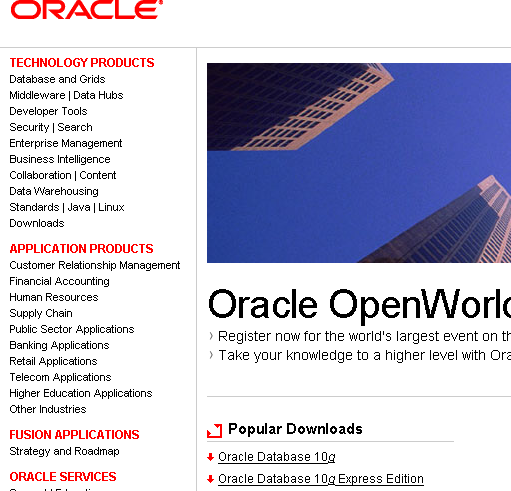
Figure 3-31. A vertical menu of the left side of Oracle.com
Vertical menus can also appear elsewhere on the page, such as for related links further down or for adaptive navigation, both discussed further in Chapter 4.
Read now
Unlock full access


 O’Reilly covers everything we've got, with content to help us build a world-class technology community, upgrade the capabilities and competencies of our teams, and improve overall team performance as well as their engagement.I wanted to learn C and C++, but it didn't click for me until I picked up an O'Reilly book. When I went on the O’Reilly platform, I was astonished to find all the books there, plus live events and sandboxes so you could play around with the technology.I’ve been on the O’Reilly platform for more than eight years. I use a couple of learning platforms, but I'm on O'Reilly more than anybody else. When you're there, you start learning. I'm never disappointed.I'm always learning. So when I got on to O'Reilly, I was like a kid in a candy store. There are playlists. There are answers. There's on-demand training. It's worth its weight in gold, in terms of what it allows me to do.