June 2007
Beginner to intermediate
950 pages
27h 8m
English
Because of the lazy evaluation practised by R, it is very simple to deal with missing arguments in function calls, giving the user the opportunity to specify the absolute minimum number of arguments, but to override the default arguments if they want to. As a simple example, take a function plotx2 that we want to work when provided with either one or two arguments. In the one-argument case (only an integer x> 1 provided), we want it to plot z2 againstz for z = 1 to x in steps of 1. In the second case, when y is supplied, we want it to plot y against z for z = 1 to x.
plotx2 <- function (x, y=z^2) {
   z<-1:x
   plot(z,y,type="l") }
In many other languages, the first line would fail because z is not defined at this point. But R does not evaluate an expression until the body of the function actually calls for it to be evaluated (i.e. never, in the case where y is supplied as a second argument). Thus for the one-argument case we get a graph of z2 against z and in the two-argument case we get a graph of y against z (in this example, the straight line 1:12 vs. 1:12)
par(mfrow=c(1,2))
plotx2(12)
plotx2(12,1:12)
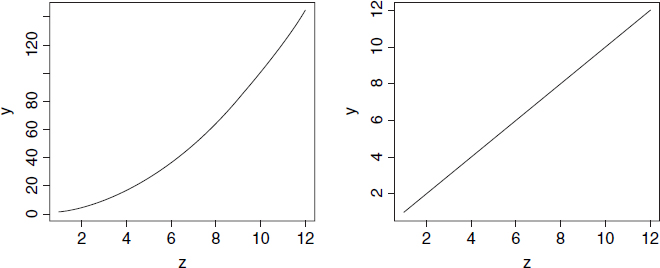
You need to specify that the type of plot you want is a line (type="l" using lower-case L, not upper-case I and not number 1) because the default is to produce a scatterplot with open circles as the plotting symbol (type="p"). If you want ...
Read now
Unlock full access


 O’Reilly covers everything we've got, with content to help us build a world-class technology community, upgrade the capabilities and competencies of our teams, and improve overall team performance as well as their engagement.I wanted to learn C and C++, but it didn't click for me until I picked up an O'Reilly book. When I went on the O’Reilly platform, I was astonished to find all the books there, plus live events and sandboxes so you could play around with the technology.I’ve been on the O’Reilly platform for more than eight years. I use a couple of learning platforms, but I'm on O'Reilly more than anybody else. When you're there, you start learning. I'm never disappointed.I'm always learning. So when I got on to O'Reilly, I was like a kid in a candy store. There are playlists. There are answers. There's on-demand training. It's worth its weight in gold, in terms of what it allows me to do.