March 2011
Intermediate to advanced
829 pages
25h 44m
English
Our next group of applications is in an area that concerns us all, on the job and especially in our private lives: money.
We usually work financial problems to the nearest dollar or nearest penny, regardless of the significant digits in the original numbers.
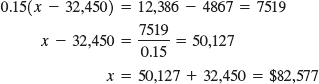
Example 30:A consultant had to pay income taxes of $4867 plus 15% of the amount by which her taxable income exceeded $32,450. Her tax bill was $12,386. What was her taxable income? Work to the nearest dollar. Solution: Let x = taxable income (dollars). The amount by which her income exceeded $32,450 is then
Her tax is 15% of that amount, plus $4867, so
Solving for x we get
Check: Her income exceeds $32,450 by ($82,577 − $32,450) or $50,127. A 15% tax on that amount is 0.15($50,127) or $7,519. Her total tax is then $7,159 + $4867 or $12,386, as required. |
Example 31:A person invests part of his $10,000 savings in a bank, at 6%, and part in a certificate of deposit, at 8%, both simple interest. He gets a total of $750 per year in interest from the two investments. How much is invested at each rate? Solution: We first define our variables. Let
and
If x dollars are invested at 6%, the interest on that investment is 0.06x dollars. Similarly, 0.08(10,000 − x) dollars are earned on the other investment. ... |
Read now
Unlock full access


 O’Reilly covers everything we've got, with content to help us build a world-class technology community, upgrade the capabilities and competencies of our teams, and improve overall team performance as well as their engagement.I wanted to learn C and C++, but it didn't click for me until I picked up an O'Reilly book. When I went on the O’Reilly platform, I was astonished to find all the books there, plus live events and sandboxes so you could play around with the technology.I’ve been on the O’Reilly platform for more than eight years. I use a couple of learning platforms, but I'm on O'Reilly more than anybody else. When you're there, you start learning. I'm never disappointed.I'm always learning. So when I got on to O'Reilly, I was like a kid in a candy store. There are playlists. There are answers. There's on-demand training. It's worth its weight in gold, in terms of what it allows me to do.