March 2011
Intermediate to advanced
829 pages
25h 44m
English
In this section we will cover a few more ideas connected with functions that will be useful in later chapters.
We have said that a function or relation can be given in forms other than an equation, such as a set of point pairs, a verbal statement, or a graph. Here we will have another look at sets of point pairs and verbal statements, and do graphing in the next chapter.
▪ Exploration:
Try this. Suppose you want to describe how "strong" or how "weak" a certain rubber band is. Hang the band from a shelf, as in Fig. 4-4, tape a ruler alongside, and use a paper clip to attach a plastic bag. Put some pennies into the bag and record the change in length of the band. Then change the number of pennies and record the length. Repeat for different numbers of pennies.
When finished, how did you report your findings? You probably expressed your results not as single numbers, but as pairs of numbers, something like the following.
| Number of Pennies | 10 | 20 | 30 | 40 | 50 |
| Inches Stretched | 1.2 | 2.4 | 3.5 | 4.9 | 6.1 |
Data such as this, resulting from observation or experiment, is called empirical data.
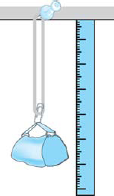
In technical work, we must often deal with pairs of numbers, rather than single values. If 10 pennies caused ...
Read now
Unlock full access


 O’Reilly covers everything we've got, with content to help us build a world-class technology community, upgrade the capabilities and competencies of our teams, and improve overall team performance as well as their engagement.I wanted to learn C and C++, but it didn't click for me until I picked up an O'Reilly book. When I went on the O’Reilly platform, I was astonished to find all the books there, plus live events and sandboxes so you could play around with the technology.I’ve been on the O’Reilly platform for more than eight years. I use a couple of learning platforms, but I'm on O'Reilly more than anybody else. When you're there, you start learning. I'm never disappointed.I'm always learning. So when I got on to O'Reilly, I was like a kid in a candy store. There are playlists. There are answers. There's on-demand training. It's worth its weight in gold, in terms of what it allows me to do.