March 2013
Intermediate to advanced
1000 pages
34h 51m
English
Recall the discussion of actions in Chapter 7. An action is a message emitted by an instance of a UIControl subclass (a control) reporting a significant user event taking place in that control. The UIControl subclasses (Chapter 25) are all simple interface objects that the user can interact with directly, like a button (UIButton), a switch (UISwitch), a segmented control (UISegmentedControl), a slider (UISlider), or a text field (UITextField).
The significant user events (control events) are listed under UIControlEvents in the Constants section of the UIControl class documentation. See Chapter 25 for a list of which controls implement which control events.
The way you hear about a control event is through an action message. A control maintains an internal dispatch table: for each control event, there is some number of target–action pairs, of which the action is a selector (the name of a method) and the target is the object to which that message is to be sent. When a control event occurs, the control consults its dispatch table, finds all the target–action pairs associated with that control event, and sends each action message to the corresponding target. This architecture is reminiscent of a notification (Figure 11-1).
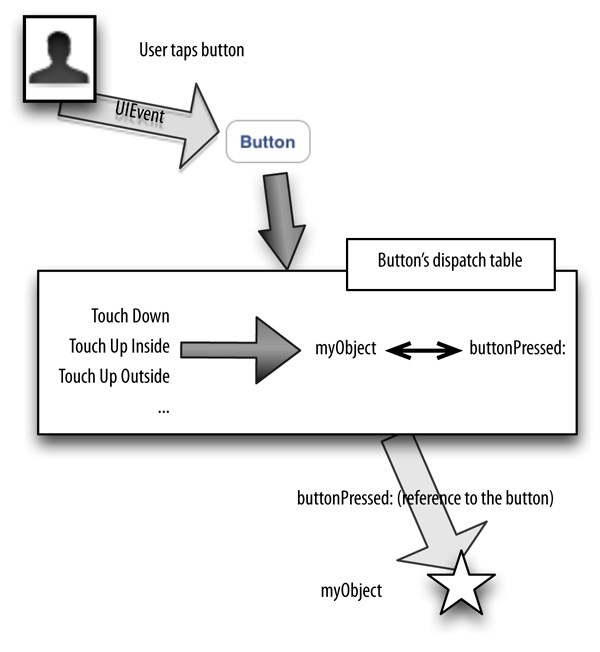
There are two ways to manipulate a control’s action dispatch table: you can configure an action connection in a nib ...
Read now
Unlock full access


 O’Reilly covers everything we've got, with content to help us build a world-class technology community, upgrade the capabilities and competencies of our teams, and improve overall team performance as well as their engagement.I wanted to learn C and C++, but it didn't click for me until I picked up an O'Reilly book. When I went on the O’Reilly platform, I was astonished to find all the books there, plus live events and sandboxes so you could play around with the technology.I’ve been on the O’Reilly platform for more than eight years. I use a couple of learning platforms, but I'm on O'Reilly more than anybody else. When you're there, you start learning. I'm never disappointed.I'm always learning. So when I got on to O'Reilly, I was like a kid in a candy store. There are playlists. There are answers. There's on-demand training. It's worth its weight in gold, in terms of what it allows me to do.