December 2015
Beginner
255 pages
4h 54m
English
Everything that can happen in a user’s mind is important when they use your design. And a few things before that. And a few after.
Wait... let’s back up for a second and talk about psychology in general
Just for a second.
Whether you’re discussing dating psychology, or consumer psychology, or bathroom psychology, (which isn’t so popular in grad school), you’re still talking about the same brain we all got on our first day.
There is no special “user” part in there.
UX Design can affect that brain in lots of predictable ways. And that’s what you’re gonna learn: your brain, on design. All practical, all the time. No history, unless it matters. Nothing philosophical, because that’s not how I roll. And no Sigmund Freud, because cocaine isn’t considered a “best practice” anymore.
Just stuff you can use.
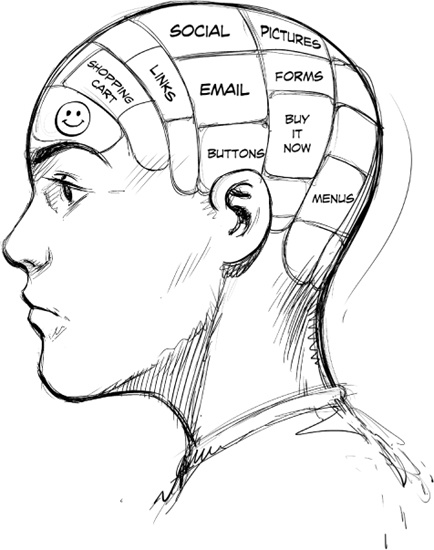
The answer: you can’t be a great UX designer without psychology.
UX Design is the practice of creating nonrandom effects in people to solve a problem. In other words, you make them feel, think, and do stuff—on purpose. Therefore, the more you understand your users’ feelings, thoughts, and actions, the better designer you are.
Understanding psychology allows you to answer things like why people share. Or why don’t they choose the cheapest option every time? Or why does the design that got 200 Likes on Dribbble actually suck the big ...
Read now
Unlock full access


 O’Reilly covers everything we've got, with content to help us build a world-class technology community, upgrade the capabilities and competencies of our teams, and improve overall team performance as well as their engagement.I wanted to learn C and C++, but it didn't click for me until I picked up an O'Reilly book. When I went on the O’Reilly platform, I was astonished to find all the books there, plus live events and sandboxes so you could play around with the technology.I’ve been on the O’Reilly platform for more than eight years. I use a couple of learning platforms, but I'm on O'Reilly more than anybody else. When you're there, you start learning. I'm never disappointed.I'm always learning. So when I got on to O'Reilly, I was like a kid in a candy store. There are playlists. There are answers. There's on-demand training. It's worth its weight in gold, in terms of what it allows me to do.