February 2005
Beginner to intermediate
608 pages
22h 4m
English
Assets that you can't convert to cash quickly, such as backhoes, buildings, or the new Deep Thought supercomputers, are called fixed assets. If you track information about your fixed assets in another program or have only a few fixed assets, there's no reason to bother with the Fixed Asset Item List. As shown in Figure 5-7 the Fixed Asset Item list tracks information, such as when you bought the asset and how much you paid. But in QuickBooks Pro, you have to calculate depreciation (see the How Depreciation Works box) for each asset at the end of the year and create journal entries (page 364) to adjust the values in your asset accounts.
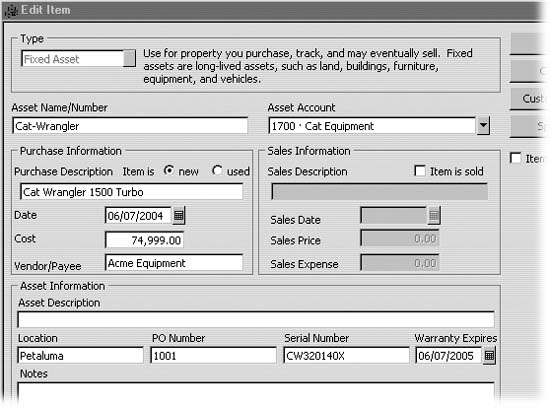
Figure 5-7. When you buy a fixed asset, you can create a Fixed Asset Item and enter its name and purchase information, where you keep it, the item's serial number, and when the warranty expires. When you create a Fixed Asset Item, QuickBooks doesn't automatically add the purchase price to the Asset Account you choose. As explained on page 272, the account you choose in your purchase transaction (check or credit card charge, for instance) is what adds the purchase price to the Fixed Asset account in your Chart of Accounts.
QuickBooks Premier Accountant Edition and QuickBooks Enterprise Edition include the Fixed Asset Manager, which not only figures out the depreciation on your assets, but applies that depreciation to your fixed asset ...
Read now
Unlock full access


 O’Reilly covers everything we've got, with content to help us build a world-class technology community, upgrade the capabilities and competencies of our teams, and improve overall team performance as well as their engagement.I wanted to learn C and C++, but it didn't click for me until I picked up an O'Reilly book. When I went on the O’Reilly platform, I was astonished to find all the books there, plus live events and sandboxes so you could play around with the technology.I’ve been on the O’Reilly platform for more than eight years. I use a couple of learning platforms, but I'm on O'Reilly more than anybody else. When you're there, you start learning. I'm never disappointed.I'm always learning. So when I got on to O'Reilly, I was like a kid in a candy store. There are playlists. There are answers. There's on-demand training. It's worth its weight in gold, in terms of what it allows me to do.