February 2005
Beginner to intermediate
608 pages
22h 4m
English
At first glance, entering bills and then paying them might seem like more work than just writing a check. But as you'll learn in this chapter, after you enter bills in QuickBooks, the program makes it incredibly easy to pay them.
To enter bills in QuickBooks, choose any of the following methods to open the Enter Bills dialog box:
In the QuickBooks icon bar, click Bill.
Choose Vendors→Enter Bills.
In the Vendor Navigator window, click Enter Bills.
If you've already invoiced your customers for products and services, the fields on a vendor's bill are old friends. In fact, if your vendors use QuickBooks, the bills you receive are just another company's QuickBooks invoices or statements (see Chapter 8).
With the Enter Bills dialog box open, here's what you do to enter a bill in QuickBooks:
In the Vendor box, choose the vendor who billed you.
As you can see in Figure 10-1, QuickBooks fills in some information for you.
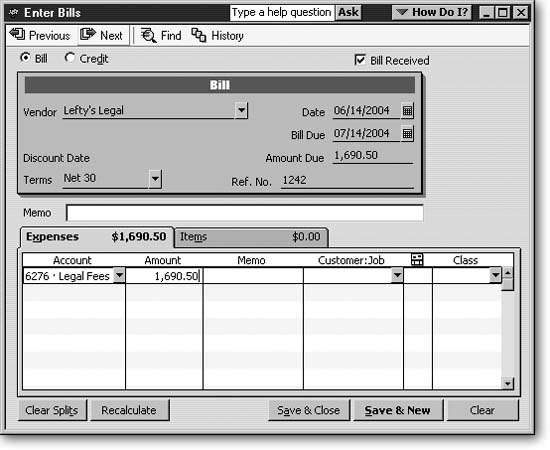
Figure 10-1. QuickBooks automatically chooses the Bill option, so you can record a vendor bill. It turns on the Bill Received checkbox, because you rarely enter a bill you haven't received. Turn off this checkbox only if you receive a shipment of inventory without a bill, which you'll learn about on page 293. The program displays the Expenses tab, which is where you enter information about expenses such as utility bills, credit card bills, and your accountant's ...
Read now
Unlock full access


 O’Reilly covers everything we've got, with content to help us build a world-class technology community, upgrade the capabilities and competencies of our teams, and improve overall team performance as well as their engagement.I wanted to learn C and C++, but it didn't click for me until I picked up an O'Reilly book. When I went on the O’Reilly platform, I was astonished to find all the books there, plus live events and sandboxes so you could play around with the technology.I’ve been on the O’Reilly platform for more than eight years. I use a couple of learning platforms, but I'm on O'Reilly more than anybody else. When you're there, you start learning. I'm never disappointed.I'm always learning. So when I got on to O'Reilly, I was like a kid in a candy store. There are playlists. There are answers. There's on-demand training. It's worth its weight in gold, in terms of what it allows me to do.