October 2012
Beginner to intermediate
398 pages
10h 22m
English
The way you report your data is almost as important as the data itself. Remember, reporting is story telling. Make your report simple, interesting, and insightful. The essential component is that it should present actionable business-related data. Reports on HR’s headcount, budget, and number hired or trained are not what management wants.
I prefer an integrated approach to reporting. By that, I mean, when appropriate, the report should include strategic, operational and predictive, or leading indicators related to one another. A C-level executive should be shown how your project is of strategic importance. That is, how it affects corporate QIPS. Then you show the operational driver that you have solved and how it positively affects internal cost, time, quantity, quality, or employee reactions. That leads to strategic level gains. Finally and hopefully, you should report how this will affect one or more of the leading indicators listed previously. At that point, you are truly presenting predictive analytics. Exhibit 11.4 is a diagram of the concept. If you want to take it to the next level of prescriptive analytics, you need to run optimization analytics to show how the many variables are connected and interdependent.
Exhibit 11.4 Integrated Reporting
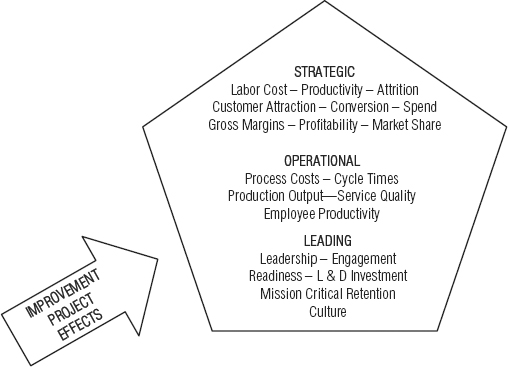
In this type of format management, one can see the simple connections. That is the most essential aspect, from HR’s ...
Read now
Unlock full access


 O’Reilly covers everything we've got, with content to help us build a world-class technology community, upgrade the capabilities and competencies of our teams, and improve overall team performance as well as their engagement.I wanted to learn C and C++, but it didn't click for me until I picked up an O'Reilly book. When I went on the O’Reilly platform, I was astonished to find all the books there, plus live events and sandboxes so you could play around with the technology.I’ve been on the O’Reilly platform for more than eight years. I use a couple of learning platforms, but I'm on O'Reilly more than anybody else. When you're there, you start learning. I'm never disappointed.I'm always learning. So when I got on to O'Reilly, I was like a kid in a candy store. There are playlists. There are answers. There's on-demand training. It's worth its weight in gold, in terms of what it allows me to do.