November 2009
Intermediate to advanced
432 pages
11h 18m
English
With no exceptions that I am aware of, Google AdWords campaigns are not as successful at the beginning as they can be. This implies that success comes via iteration. With your feedback mechanism in place as I’ve suggested earlier in this chapter, you can take even a relatively poorly performing AdWords campaign and tweak it to make it much better. To use successful iteration, you need to be tracking your AdWords campaigns, and you need multiple ad variations. It’s amazing how much impact even a small change in wording in an ad can have!
Basically, for each ad variation you should be tracking impressions, clicks, CTR, and conversions.
As shown in Figure 12-1, iteration is basically a simple process. You start with two related ads, run them a lot of times, and compare the results. Drop the poorer performing of the two ads and create another variation. Repeat the performance.
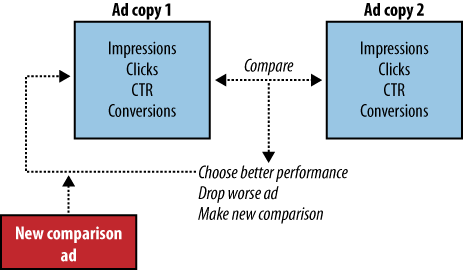
Figure 12-1. Iteration means replacing each ad that performs poorly with another ad, and then repeating the comparison
Before doing your comparisons, make sure you have enough ad impressions so that the results are statistically significant.
There’s also an issue if all your metrics don’t agree. Suppose Ad A gets you a higher CTR than Ad B, but Ad B does better in terms of conversions (always assuming you have enough data on which to base conclusions). In this situation—which does come up in ...
Read now
Unlock full access


 O’Reilly covers everything we've got, with content to help us build a world-class technology community, upgrade the capabilities and competencies of our teams, and improve overall team performance as well as their engagement.I wanted to learn C and C++, but it didn't click for me until I picked up an O'Reilly book. When I went on the O’Reilly platform, I was astonished to find all the books there, plus live events and sandboxes so you could play around with the technology.I’ve been on the O’Reilly platform for more than eight years. I use a couple of learning platforms, but I'm on O'Reilly more than anybody else. When you're there, you start learning. I'm never disappointed.I'm always learning. So when I got on to O'Reilly, I was like a kid in a candy store. There are playlists. There are answers. There's on-demand training. It's worth its weight in gold, in terms of what it allows me to do.