February 2006
Intermediate to advanced
826 pages
63h 42m
English
To see how the basic table elements are applied, consider a simple table with two rows and two columns (four content or “data” cells). The diagram on the left in Figure 13-3 shows the table with its cells and rows labeled in the way they are recognized in HTML. The diagram on the right shows the HTML elements that correspond with each component.
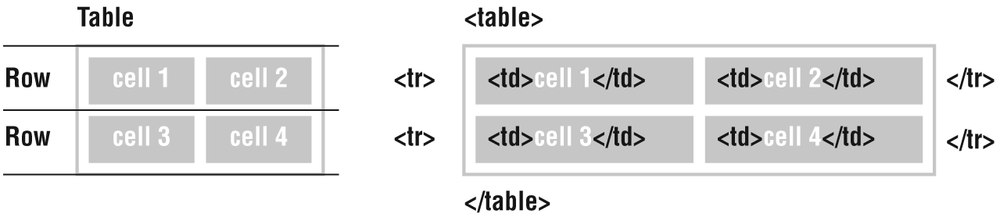
Figure 13-3. Basic table structure
Written out in an HTML source document, the markup for the table in Figure 13-3 would look more like this:
    <table>
    <tr>
         <td>cell 1</td><td>cell 2</td>
    </tr>
    <tr>
         <td>cell 3</td><td>cell 4</td>
    </tr>
    </table>
The entire table is indicated by the table element, which has no content of its
own, but acts as a containing element for one or more of table row
elements (tr). The table in the
example contains two rows. Each tr
element, in turn, contains two data cells, which
are indicated by the td elements.
The cells are the elements that contain real content; the table and tr elements are purely for table structure.
A table cell may contain any data that can be displayed in a document,
including formatted text, images, multimedia elements, and even other
tables.
As mentioned earlier, the table system in HTML is row-primary.
Rows are labeled explicitly, but the number of columns is just implied
by the number of cells in the longest row. In other words, if all the
rows have three cells (three td elements), then the table ...
Read now
Unlock full access


 O’Reilly covers everything we've got, with content to help us build a world-class technology community, upgrade the capabilities and competencies of our teams, and improve overall team performance as well as their engagement.I wanted to learn C and C++, but it didn't click for me until I picked up an O'Reilly book. When I went on the O’Reilly platform, I was astonished to find all the books there, plus live events and sandboxes so you could play around with the technology.I’ve been on the O’Reilly platform for more than eight years. I use a couple of learning platforms, but I'm on O'Reilly more than anybody else. When you're there, you start learning. I'm never disappointed.I'm always learning. So when I got on to O'Reilly, I was like a kid in a candy store. There are playlists. There are answers. There's on-demand training. It's worth its weight in gold, in terms of what it allows me to do.